Let R be a ring. Let n > 0. Let M be an R-module generated by < n elements. Let f : R⊕ n —> M be an R-module map. Then Ker(f) is nonzero. See Lemma Tag 05WI.
Slogan: R^{n + 1} —> R^n cannot be injective.
Let R be a ring. Let n > 0. Let M be an R-module generated by < n elements. Let f : R⊕ n —> M be an R-module map. Then Ker(f) is nonzero. See Lemma Tag 05WI.
Slogan: R^{n + 1} —> R^n cannot be injective.
There is a new chapter entitled “Pushouts of Algebraic Spaces”. Here is a link to the introduction. It contains a section on something that is often called formal glueing of quasi-coherent modules. The name presumably comes from the fact that this can be used and is often used to glue coherent sheaves on Noetherian schemes given on an open and on the formal completion along the closed. However, the mathematics is more like what one does when studying elementary distinguished squares in the Nishnevich topology — in fact, I wonder what topology we get if we replace elementary distinguished squares by the notion in Situation Tag 0AEV? Hmm…
Let A be a ring and let I ⊂ A be a finitely generated ideal. The local cohomology functor and derived completion functor define quasi-inverse equivalences of categories D_{I∞-torsion}(A) <---> D_{comp}(A,I). See Proposition Tag 0A6X.
This and more general statements can be found in Dwyer-Greenlees. As usual more references are welcome. Thanks!
Let (A,I) be a henselian pair with A Noetherian. Let A^* be the I-adic completion of A. Assume at least one of the following conditions holds
Given f_1, …, f_m ∈ A[x_1, …, x_n] and a_1, …, a_n ∈ A^* such that f_j(a_1, …, a_n) = 0 for j = 1, …, m, for every N ≥ 1 there exist b_1, …, b_n ∈ A such that a_i − b_i ∈ I^N and such that f_j(b_1, …, b_n) = 0 for j = 1, …, m. See Lemma Tag 0AH5.
Slogan: Approximation for henselian pairs.
Let A be a ring and let I be a finitely generated ideal. Let M and N be I-power torsion modules.
See Lemma Tag 0592.
Discussion: Let A be a ring and let I be an ideal. The derived category of complexes of A-modules with I-power torsion cohomology modules is not the same as the derived category of the category of I-power torsion modules in general, even if I is finitely generated. However, if the ring is Noetherian then it is true, see Lemma Tag 0955.
There exists a local ring R with a unique prime ideal and a nonzero ideal I ⊂ R which is a flat R-module. See Section Tag 05FZ.
Slogan: Zero dimensional ring with flat ideal.
Hello again. This just a quick post to let you know that I worked through your recent comments and updated the Stacks project website with the latest version. So get back there and find more mistakes. Thank you all!
Let F be a predeformation category which has a versal formal object. Then
See Lemma Tag 06T5.
What is fun about this lemma is that it produces a minimal versal object (as defined in Definition Tag 06T4) from a versal one without assuming Schlessinger’s axioms. If Schlessinger’s axioms are satisfied and one is in the classical case (see Definition Tag 06GC), then a minimal versal formal object is a versal formal object defined over a ring with minimal tangent space. This is discussed in Section Tag 06IL.
Let h : X –> Y, g : Y –> B be morphisms of algebraic spaces with composition f : X –> B. Let b ∈ |B| and let Spec(k) → B be a morphism in the equivalence class of b. Assume
Then there is an open subspace B′ ⊂ B containing b such that X_{B′} → Y_{B′} factors through a closed subspace Z ⊂ Y_{B′} finite over B′. See Lemma Tag 0AEJ.
Slogan: Collapsing a fibre of a proper family forces nearby ones to collapse too.
Let (A,m) be a Noetherian local ring. Let I ⊂ J ⊂ A be proper ideals. Assume
Then I is generated by a regular sequence and J/I is generated by a regular sequence. See Lemma Tag 09PW.
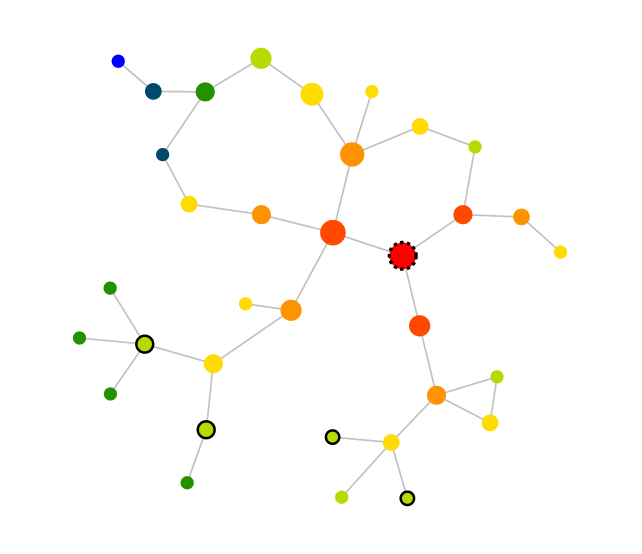
Here is the graph of this lemma