Group(oid) spaces

At the moment I am writing a chapter on groupoid spaces. In this chapter I introduce the notion of a “group space” and the notion of a “groupoid space”. Of course, most of the theory is exactly the same as for groupoid schemes, so in fact I am simply editing a copy of the chapter on groupoid schemes. What I am wondering is whether it is OK to use “groupoid space”‘ and “group space”, or if I should use the longer and perhaps more correct “algebraic groupoid space” and “algebraic group space”? Or, is it better to use “groupoid in algebraic spaces” and “group algebraic space”?

For now I’ll stick to my first choice, but if you object please leave a comment.

Stacks in groupoids

Here is a question somebody asked today which used to be answered in an older version of the stacks project, but which got excised a while ago.

The question is: How different are the notions of a stack in groupoids and a sheaf of groupoids?

The answer is that there are 2 differences. The first is a minor one: Although every stack in groupoids is equivalent to a split category fibred in groupoids, it is not always isomorphic to one. Here a split category fibred in groupoids over a category is the category associated to a contravariant functor from the category into the category of groupoids. Of course such a functor is nothing else than a presheaf F of groupoids on the site.

The second difference is more serious. Namely, when you say that F is a sheaf, then apart from the requirement that morphisms descend you are only requiring that descent data for objects are effective for a somewhat restrictive class of descent data. In fact you are only requiring that if x_i are objects of the split fibred category over the members U_i of the covering, and if the restrictions x_i|_{U_i \times_U U_j} and x_j|_{U_i \times_U U_j} are equal then this should be effective. Clearly this is different from the requirement that all descent data are effective.

The “explanation” of this in the earlier version of the stacks project is that the category F(U) should be the homotopy limit of the diagram

\prod F(U_i) ==> \prod F(U_i \times_U U_j) ==> \prod F(U_i \times_U U_j \times U_k)  …

and not the usual limit. And of course this is a nice way of saying it since it leads to possible generalizations such as higher stacks.

Update

The semester is starting today, so I will have less time to work on the stacks project unfortunately. In any case, after some revisions to “Morphisms of Spaces” and adding the necessary lemmas to “Descent on Spaces”, I have now started to edit the chapter “Algebraic Stacks”. This chapter is only going to have the stuff comparing the different ways of thinking about algebraic stacks (including presentations), and some examples. My idea is that we do not use the customary abuse of language (such as a scheme is a stack) in that chapter but in the chapters following it we do. So the first chapter on algebraic stacks is awkward, and the later chapters less so. In fact, I think I won’t even mention the separation axioms in that chapter since it works better in a chapter on morphisms of algebraic stacks.

Functorial point of view

If you take a look at the current version of the stacks project you will see that essentially the last chapter is the one on algebraic stacks, and moreover that it is practically empty. Why?

One of the decisions made early on was to build up the material along historical lines in the usual manner. Namely:

  1. We develop some commutative algebra and some theory of sheaves on topological spaces.
  2. We define schemes as locally ringed spaces which locally look like the spectrum of a ring.
  3. We develop the theory of sheaves on a site and we discuss schemes and morphisms of schemes. We define the big fppf/etale site of a scheme. We also discuss in some detail the notion of descent for schemes and descent of properties of morphisms of schemes.
  4. We define algebraic spaces as fppf sheaves which etale locally look like a scheme.
  5. We study the notion of stacks fibred in groupoids over a site. We study properties of algebraic spaces and morphisms of algebraic spaces. We study descent for algebraic spaces.
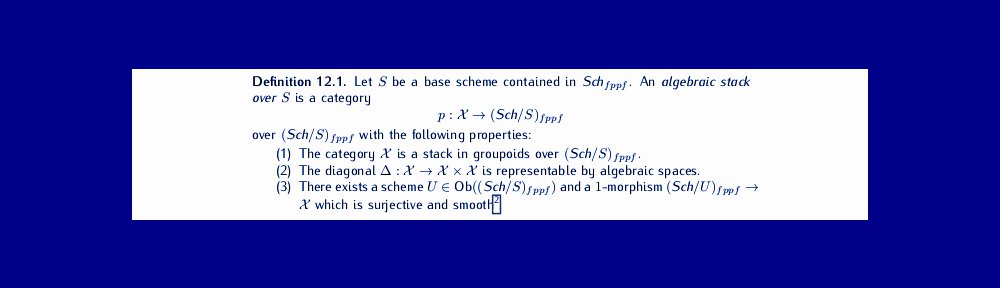
  6. Finally we use this material to define algebraic stacks as stacks fibred in groupoids on the category of schemes in the fppf topology whose diagonal is representable by algebraic spaces and which have a smooth covering by a scheme.

This seems like a bit of overkill at first. Why can’t we do a little bit of commutative algebra, and then go straight to the definition of algebraic stacks as certain stacks fibred in groupoids over the opposite category of the category of rings endowed with the fppf topology?

The answer is of course that in principle you can do this. One advantage of doing this is that you might not have the kind of repetition that the progression 1,2,3,4,5,6 above shows. Moreover, every geometric object would be an algebraic stack and you would not have to use the customary abuse of notation (such as statements of the form “a scheme is an algebraic stack”) which one finds in papers on algebraic stacks. In fact, feel free to clone the stacks project and to rewrite it in this way.

On the other hand, any full discussion of the theory of algebraic stacks is going to mention affine schemes, schemes, and algebraic spaces. It will still be the case that the most interesting objects of study are algebraic varieties, and their moduli spaces. For example curves, abelian varieties, and Jacobians of curves, moduli spaces of such, Shimura varieties, K3-surfaces, etc, etc. Proofs of foundational theorems such as “coherence of proper pushforward”, or Zariski’s Main Theorem will likely still be proved by proceeding via arguments through the case of schemes.

Currently, the arguments dealing with schemes and morphisms of schemes are of a different nature than those for algebraic spaces and the arguments dealing with algebraic spaces will be I am sure of a different nature again. This means that there is actually less repetition in the sequence 1,2,3,4,5,6 as one expects at first. Also, when working on a new result for say algebraic spaces, by first proving the needed algebra lemmas, then proving the results for schemes, and finally the result for algebraic spaces, we automatically organize the material, and we prove each result in its natural setting.

A related observation is that the reader need only know about schemes when reading any of the results in the theory of schemes. (Of course eventually we will prove results which can be formulated in the language of schemes but whose proof uses algebraic stacks.) Similarly for the algebra results and the results on algebraic spaces.

There is also a psychological component. Sure you can define algebraic stacks without first defining any intermediate geometric objects. However, once this is done, there you are, and there is nothing that you can hold onto and relate the objects to… it seems  a bit similar to introducing quantum physics without first talking about classical mechanics. Sure it is fundamentally more important, but what is it really telling us about the real world?
Introduction

This is a blog about algebraic geometry and more specifically algebraic stacks and the stacks project. So let’s start with some basic information on the stacks project.

The stacks project is an open source text book on algebraic stacks and the algebraic geometry that is needed to define them. The current version of the complete book can always be found here.

How can you contribute? You can leave comments on this blog if you want to give feedback in an informal manner. Another simple way is to download the tex file and the pdf file of a chapter, and while you are reading correct any typos, or mathematical errors you see. At the end simply email the new tex file to stacks.project@gmail.com. You can take a look at the todo-list to see what needs to be done.