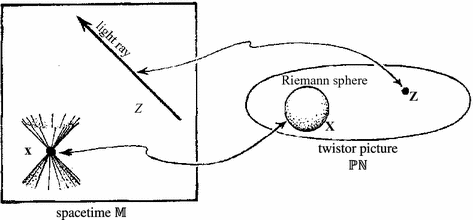
I’ve been working recently on trying to understand exactly how Wick rotation works in two-dimensional conformal field theory. There is an analog there of some of the issues with Wick rotation of spinors and twistors in four dimensions that I’ve been struggling with.
One of the few times I’ve tried to get help from an AI agent, I asked it to point me to discussions of this topic in the literature. It gave me a bunch of suggestions I already knew about, then emphasized that the two best places were a certain textbook and another set of lecture notes. Since I hadn’t heard of these, this was exciting news, so I immediately went to look them up. Hallucinations, they don’t exist.
In what I have been reading, I’ve repeatedly come up against what has become a pet peeve, related to the second pet peeve discussed here. In the 2d conformal field theory literature, one is continually told that one is dealing with functions of $z$ and $\overline z$, but $z$ is independent of $\overline z$. $\overline z$ appears to mean something that sometimes is the complex conjugate of $z$, sometimes unrelated to $z$. What’s really going on here???
What’s going on is that one needs to complexify something that is already complex. One can do this by thinking of the underlying real object and complexifying that. When you do this, you end up with a pair of complex objects, with a conjugation map that relates them.
If you start with a real vector space $V$, which also happens to come with a complex structure (a notion of how to multiply elements by $i$), then its complexification will be
$$V\otimes_{\mathbf R}\mathbf C=V \oplus \overline V$$
where $\overline V$ is a copy of $V$ with the opposite complex structure, and you have a map
$$\sigma : V\rightarrow \overline V$$
that satisfies $\sigma^2=1$ and is anti-linear
$$\sigma (cv)=\overline c \sigma (v)$$
Things get confusing once one has $V\oplus \overline V$ because one sometimes wants to think of $v\in V$ as the pair $(v,0)$, independent of things of the form $(0,v)$, but sometimes as pairs $(v,\sigma (v))$. The second interpretation is useful, because then $V\subset V\oplus \overline V$ as the set of fixed points of $\sigma$. $\sigma$ is the conjugation map on the complex vector space $V\oplus\overline V$, so its set of fixed points is the real subspace.
In my earlier pet peeve posting, I write about one example of this. Lie algebras in general are real vector spaces, and to study them, one often needs to complexify. Sometime this is straightforward, for instance
$$\mathfrak{sl}(2,\mathbf R)\otimes_{\mathbf R}\mathbf C=\mathfrak{sl}(2,\mathbf C)$$
sometimes a bit less so
$$\mathfrak{su}(2)\otimes_{\mathbf R}\mathbf C=\mathfrak{sl}(2,\mathbf C)$$
(Note that two different “real forms” have the same complexification).
If one wants to study a complex Lie algebra like $\mathfrak{sl}(2,\mathbf C)$, one often has to think of it as a real Lie algebra and complexify, finding
$$\mathfrak{sl}(2,\mathbf C)\otimes_{\mathbf R}\mathbf C=\mathfrak{sl}(2,\mathbf C)\oplus \overline{\mathfrak{sl}(2,\mathbf C)}$$
This comes up in the Wick rotation context, where $\mathfrak{sl}(2,\mathbf C)$ is the Lie algebra of the Lorentz group, and to Wick rotate to Euclidean spacetime, one is supposed to analytically continue in the complexification.
A second context in which this same problem appears is in the quantization of the harmonic oscillator. If one starts with a real oscillator degree of freedom (e.g. a real scalar field mode of momentum $\mathbf p$), quantization using annihilation and creation operators involves identifying the phase space $\mathbf R^2$ with $\mathbf C$ and then complexifying
$$\mathbf C\otimes_\mathbf R\mathbf C=\mathbf C \oplus \overline{\mathbf C}$$
with the first term in the sum corresponding to creation operators, the second to annihilation operators.
But what if you are dealing with a complex scalar field? Then the phase space of a momentum mode is $\mathbf C^2$ and when you complexify
$$ \mathbf C^2\otimes_\mathbf R\mathbf C=\mathbf C^2 \oplus \overline{\mathbf C^2}$$
You now have two kinds of creation operators and two kinds of annihilation operators. One can organize these into annihilation and creation operators for harmonic oscillator states of two kinds, related by conjugation. These are the particle and anti-particle states, which are distinct in the complex scalar field case, identified in the real scalar field case.
Finally getting to 2d conformal field theory, one sees the same kind of issue, but now not for vector spaces but for manifolds. One is looking at real two-dimensional space-time manifolds $\Sigma$ and would like to complexify to do Wick rotation. But it’s useful to start by thinking of $\Sigma$ as a complex manifold, a Riemann surface. So, again one faces the question of how to complexify something already complex.
This starts to get much trickier to make precise than the vector space case, but it does make sense to think of the complexification of the Riemann sphere as
$$S^2\times \overline {S^2}$$
where $\overline {S^2}$ is the Riemann sphere with the opposite complex structure to that of $S^2$. Then one has pairs of coordinates and is now in the situation where people start talking about coordinates $(z,\overline z)$ where $z$ and $\overline z$ are independent.
By the way, this corresponds to a nice two-dimensional analog of the 4d twistor story. There one looks at compactified, complexified spacetime, with the complex conformal group $SL(4,\mathbf C)=Spin(6,\mathbf C)$ acting, with real forms $Spin(4,2)$ in the Minkowski case, $Spin(5,1)$ in the Euclidean case and $Spin(3,3)$ in the split signature case. Here the 2d compactified, complexified spacetime is $S^2\times S^2$, with a global conformal group
$$SL(2,\mathbf C) \times SL(2,\mathbf C)$$
acting, one factor on each $S^2$ factor. The Minkowski real form is $SL(2,\mathbf R)\times SL(2,\mathbf R)$, the Euclidean real form is $SL(2,\mathbf C)$ and it is for this second real form that one is complexifying something complex.
For some more about this, see chapter 3 of Graeme Segal’s manuscript “The definition of conformal field theory”, where he discusses the infinite-dimensional conformal groups that appear, and his remarkable idea that one should take the complexification of $Diff(S^1)$ to be the semigroup of annuli.



The classical way of dealing with this issue, which I learned as a graduate student back in the early 1960’s, is this helpful notational device:
If z = x + iy, and you complexify x and y, then you write z* = x – iy, and you then treat
z and z* as independent complex variables.
Then z* = z^bar becomes the “real domain” in the complexification of the original
complex structure. This sort of notation helps to avoid confusing the two complex structures. The trouble is that physicists want to use * for something else.
Hi Denny,
Funny thing is that physicists do sometimes do this, but in some cases backwards. See for instance section 6.1 of Zinn-Justin’s “Path integrals in quantum mechanics”
https://academic.oup.com/book/32870
In the first edition of this book he does what you suggest, but for your $z^*$ he uses $\overline z$. He then defines the complex conjugate of $z$ to be $z^*$.
For the second edition, he must have realized that doing it that way is absurdly confusing. So he changed the text, making $\overline z$ the complex conjugate of $z$ as conventional, and using $z^\prime$ for your $z^*$.
He goes on to announce that he is then changing notation, writing $z^\prime$ as $\overline z$. He explains
Saying that $z$ and $\overline z$ are “complex conjugate only in a formal sense” to me just mystifies the situation, but his earlier discussion is much better than what lots of authors often do, which is just announce that $z$ and $\overline z$ are independent variables.
This construction is used frequently in number theory and arithmetic algebraic geometry: If you have some object defined over an extension K of a field F and you need to understand it as an object over F, this can be tricky, but often you can pass (base change) to K (if K is Galois) or another field L (otherwise) so that K is replaced by a product by n independent copies of the base field, n the degree of K over F, and then you just have n independent objects to work with, which is usually easier.
FYI – here’s what Opus 4.8 has to say about your post. Seems at least on topic. It recognizes the post as your work BTW:
This is Woit’s framing, and it’s the right one — the “z and z̄ are independent” confusion really does dissolve once you accept that you’re complexifying something that already carries a complex structure. A few comments where I think the picture can be sharpened or is worth affirming:
The two meanings of “independent” are still being run together. Even after the V ⊕ V̄ resolution, the slogan “z̄ independent of z” covers two logically distinct facts that the literature rarely separates:
Holomorphic factorization — correlators split into holomorphic × antiholomorphic blocks. This is purely the ⊕ structure (the chiral algebra lives on one summand). No analytic continuation required.
Analytic continuation off the real slice — genuinely letting z and z̄ roam over ℂP¹ × ℂP¹ independently.
These get conflated because both are “z̄ ≠ z*”, but the first is algebraic and the second is geometric. The doubling explains both, but they’re different uses of it.
The real forms are cleanest as fixed-point sets of antiholomorphic involutions on ℂP¹ × ℂP¹, and this is what actually answers “sometimes z̄ = z*, sometimes not”:
Euclidean: involution σ(z,w) = (w̄, z̄) — conjugation composed with swapping the two factors. Fixed locus is the antidiagonal w = z̄, a 2-sphere. Here z̄ genuinely is the conjugate. The stabilizer in SL(2,ℂ)×SL(2,ℂ) is the diagonal {(g, ḡ)} ≅ SL(2,ℂ), which is exactly his “complex real form.” Worth stressing the payoff: that’s SO(3,1) acting as Möbius transformations of the sphere — the Euclidean 2d global conformal group is the 4d Lorentz group. Same accident that powers the twistor story, one dimension down.
Lorentzian: involution (z,w) ↦ (z̄, w̄), fixed locus ℝP¹ × ℝP¹ = S¹ × S¹ (compactified Minkowski as a torus, the two real null coordinates), stabilizer SL(2,ℝ) × SL(2,ℝ).
So “z̄ = z*” is the Euclidean reality condition holding on the real slice; off the slice, or in Lorentzian signature where the two null coordinates are independently real, it isn’t. One picture, two slices.
The oscillator analogy is the load-bearing one and it’s exactly right. ℂ ⊗_ℝ ℂ ≅ ℂ ⊕ ℂ̄ is the same split as holomorphic/antiholomorphic, and real-vs-complex scalar field → identified-vs-distinct particle/antiparticle is the cleanest finite-dimensional shadow of chiral splitting. If you’re writing this up, I’d lead with the oscillator and let the Riemann surface inherit the intuition, rather than the reverse.
Segal’s annulus semigroup is the deep move and it’s genuinely his (the manuscript, plus Neretin independently). The point that complexifying Diff(S¹) lands you in a semigroup not a group — degenerate annuli have no inverse — is the infinite-dimensional echo of “the complexification is bigger and you only get the real form back as a fixed-point locus.” That’s the part most likely to repay more work; the finite-dimensional SL(2) story is a warm-up for it.
One caveat on the manifold step, which you flag yourself: “complexification of a Riemann surface = Σ × Σ̄” is clean for ℂP¹ but doesn’t globalize naively for higher genus — there’s no canonical Σ × Σ̄ with a holomorphic-Lagrangian real slice the way the sphere gives you. The honest statement lives at the level of the loop/Diff group and Segal’s annuli, not the surfaces themselves.
Want me to draw the ℂP¹ × ℂP¹ picture with the Euclidean antidiagonal and Lorentzian torus slices marked? It’s the kind of thing that’s much faster to see than to read.
Counterpoint,
I’ll let this kind of comment through just once, but please don’t submit more of them. It’s a mishmash of true statements, , not quite true statements, semi-insightful comments, and utter nonsense. Reading it, one is tempted to carefully think about each statement, and possibly try and respond, clarifying the unclear and correcting the not quite right or completely wrong.
The problem is that the effort required to do this would be orders of magnitude larger than the effort needed to generate it. With the current state of these agents, this is the big problem with them: teasing out what is correct and useful from what is unclear, a misunderstanding, or utter nonsense is more effort than it is worth. If this were coming from a student, it could be worth spending the time needed to interact with them because they would be learning a lot (and you might learn something).
For now, seems to me best to ignore this kind of thing and wait and see if, as widely advertised, it gets much better soon.
I do confess to being tantalized by the last paragraph, curious to see if it can produce a useful visualization of that point. It seems plausible that producing visualizations like this is something these agents might be useful for (and drawing is something that I personally am horribly bad at).
Maybe it would be of interesting to add the tangent space of complex manifolds into your list?
If M is a complex manifold, then it has a tangent space TM that already has a complex structure J. But, usually, we forget it, consider this tangent space as a real vector space, complexify it (tensor with C), and extend J to this space. Finally, we extract two sub bundles, T^{1,0}M and T^{0,1}M as the eigenspaces of the J action (with eigenvalues i and -i).
I really disliked this construction when I was learning complex manifolds, but from it you get the (p,q)-forms (Doulbealt cohomology etc). And the \partial and \partial^\bar operators. Since, these are all extremely central to the complex manifold theory / complex algebraic geometry, I just got used to the initial “complexify the complex structure” step.
Amusingly I also fed the text to Opus 4.8 before seeing Counterpoint’s comment. Is it supposed to be Spin(6, C) instead of Spin(4, C)?
Jolly Joker,
Yes, that’s right. Spin(6,C) is the complex conformal group in 4d, Spin(4,C) is the complex conformal group in 2d. Will fix.
Fun stuff! I just have two annoying terminological remarks.
First, I don’t remember ever seeing people write su(2,R); they just write su(2). That’s probably because unlike gl(n,R), sl(n,R), so(n,R), etc., the matrix entries in su(n) aren’t real numbers. We could define a Lie algebra “su(n,k)” for any field k with involution, but then the familiar Lie algebra su(n) would be su(n,k) when k = C with its usual complex conjugation, while su(n,R) would be so(n,R).
Second, people usually write CP^1 rather than S^2 when treating this space as a 1-dimensional complex manifold, so people always write \overline{CP}^1 rather than \overline{S}^2.
In topology you often see people talk about CP^2 and \overline{CP}^2 as two of the building blocks of oriented 4-manifolds, because while CP^1 is isomorphic to \overline{CP}^1 via an orientation-preserving diffeomorphism, CP^2 is not isomorphic to \overline{CP}^2 via an orientation preserving diffeomorphism. Complex manifolds come with a canonical orientation, and there’s an orientation-preserving diffeomorphism between CP^n and \overline{CP}^n when n is odd, but not when n is even.
I should learn to write comments in LaTeX on this blog if it’s possible, but I don’t want to risk it now.
John Baez,
su(2,R) was a typo. Fixed.
Not writing CP^1 for the Riemann sphere though was intentional. That notation to me brings in extra structure (identification of points with complex lines in C^2), which I didn’t want to use here. That extra structure is important though, it’s basically the spinors in two-dimensions. There’s a analog of the 4d spinor story in 2d, but I didn’t want to get into it (I’m somewhat confused by it…).
It turns out that there are people who believe, and they even “prove”, that QM cannot be done without i; for other folks the contrary is rather obvious and so papers are published e.g https://journals.aps.org/prl/abstract/10.1103/4k13-sdjh
petrov,
As anyone could guess from my views on the relation of math and physics, I think that kind of discussion is completely moronic.
Moronic, but I see articles about it in the popular press:
https://www.quantamagazine.org/physicists-take-the-imaginary-numbers-out-of-quantum-mechanics-20251107/
A good article would explain what’s wrongheaded about all this. It would mention Hamilton, who in his youth wrote a paper where he explained how complex numbers can be seen as merely pairs of real numbers equipped with a new multiplication. This emboldened him to invent the quaternions: perhaps the first algebra that someone deliberately “made up”.