Osterwalder-Schrader and Euclidean Spinor Fields

If one tries to Wick rotate a quantum field theory with spinor fields, it’s well-known that problems arise, something first recognized in Schwinger’s earliest papers on the subject. I’ll try and outline here the 1972 proposal by Osterwalder and Schrader (see here, here and here), which is the best known way to deal with the problem. Over the years there have been a large number of other efforts to address this issue, and I’ve put together a bibliography of those here. Many of these I’ve never been able to completely understand. I’ll concentrate on the Osterwalder-Schrader proposal since I do now understand it (I didn’t in 1984…), and it seems to correspond best to the conventional wisdom of the subject.

There’s a first indication that something funny is going on when you look at any QFT textbook discussing spinor field theory in the standard “Dirac spinor” formalism where spinors take values in $\mathbf C^4$. A good example is Pierre Ramond’s book, where chapter 5 deals with this, in both Minkowski and Euclidean signature. The Lagrangian in both cases can be written the same way, as
$$\overline \psi (i\gamma^\mu\partial_\mu -m)\psi$$
with
$$\psi=\begin{pmatrix}\psi_L\\ \psi_R\end{pmatrix}$$
If you read more closely you find out that the notation is hiding things:

  • In Euclidean signature, $\overline \psi =\psi^\dagger$, but in Minkowski signature $\overline \psi =\psi^\dagger \gamma_0$ (the “Dirac adjoint”).
  • In Euclidean signature the spin group is $Spin(4)=SU(2)_L\times SU(2)_R$, $S_L$ is the spin representation of $SU(2)_L$, and $S_R$ is the spin representation of $SU(2)_R$. In Minkowski signature the (time-orientation preserving) spin group is $Spin(3,1)=SL(2,\mathbf C)$, $S_L$ is the spin representation of $SL(2,\mathbf C)$, and $S_R$ is the complex conjugate of the spin representation.

Osterwalder and Schrader propose that Wick rotation of spinor fields involves a doubling of the number of degrees of freedom, giving up the Dirac adjoint relation, and taking $\psi$ and $\overline\psi$ to be independent fields (which they call $\psi_1$ and $\psi_2$). They show that one can then do the same kind of OS reconstruction argument as in their paper dealing with scalar fields. The OS reflection operator that in the scalar case both complex conjugated fields and reflected in imaginary time now also interchanges $\psi_1$ and $\psi_2$, as well as having a $\gamma_0$ factor that interchanges $S_L$ and $S_R$.

This proposal does what it is advertised to do, reconstructing the Wightman functions and state space of the usual Minkowksi spacetime theory, but the way it does this is somewhat unsettling. Wick rotation is not just a matter of putting some factors of i in the right place, but involves a significant change in the degrees of freedom of the theory when one passes from Minkowski to Euclidean. For scalars, OS showed that the Wick rotation of complex conjugation surprisingly also now involved a reflection in spacetime. For spinors this becomes an even more intricate piece of structure one must add to the Euclidean theory to do reconstruction.

Osterwalder-Schrader and most later authors ignore something even more problematic about Wick rotating spinors, something pointed out by Ramond in his book: it doesn’t work for a Weyl spinor field. The basic building blocks of matter fields in the Standard Model are two-component spinor fields, with the simplest building block the theory of a chiral (say right-handed) massless Weyl fermion. This theory is simple to write down, and at first glance has a simple Wick rotation, just by taking time to be complex and proceeding as for scalars.

But this runs into a fundamental issue with how the transformation properties under spacetime rotation change as one goes from Minkowski to Euclidean. It appears that if one wants to describe a massless neutrino of one chirality in Euclidean QFT, one must quadruple the number of degrees of freedom (first double the degrees of freedom to get four-component Dirac spinors, the double again according to Osterwalder-Schrader).

I’ll leave for another time discussion of the details of how spacetime rotations change under Wick rotation in the usual formalism. I’ve outlined a proposal for a very different way of understanding this issue in my Spacetime is Righthanded paper.

Posted in Uncategorized | Leave a comment

Harmonic Oscillators

This is related to the Osterwalder-Schrader posting, but is much, much more elementary. I’ll write up some basic facts about the quantum harmonic oscillator and explain what bothers me about the relation to Osterwalder-Schrader.

Every quantum mechanics course covers the quantum harmonic oscillator, generally in the Schrödinger picture, with states functions of space and time. The Hamiltonian is a second order pde, one finds its eigenfunctions and eigenvalues. For a version of this that I wrote, see chapter 22 here.

Free quantum field theories are just infinite collections of such harmonic oscillators, but in QFT one wants to use the Heisenberg picture (the Schrödinger picture would be very awkward). For a single quantum harmonic oscillator in the Heisenberg picture, one has two operators $Q(t),P(t)$, with Hamiltonian
$$H=\frac{1}{2}\left(P^2 +\omega^2 Q^2\right)$$
(here I’m rescaling so that $m=\hbar=1$). The Heisenberg equations of motion are
$$
\frac{d}{dt}Q=i[H,Q]=P,\ \ \frac{d}{dt}P=i[H,P]=-\omega^2Q
$$
Subsituting the first in the second, one gets the second-order equation of motion
$$\left(\frac{d^2}{dt^2}+\omega^2\right)Q=0$$

Such equations can most easily be solved by complexifying (allowing not just real, but complex linear combinations of solutions). Using complex linear combinations of operators, one can write
$$a=\sqrt{\frac{\omega}{2}}Q+i\sqrt {\frac{1}{2\omega}}P,\ \ a^\dagger=\sqrt{\frac{\omega}{2}}Q-i\sqrt {\frac{1}{2\omega}}P$$
which turns the first order equations into
$$\frac{d}{dt}a=-i\omega a,\ \ \frac{d}{dt}a^\dagger=i\omega a^\dagger$$
with solutions
$$a(t)=a(0)e^{-i\omega t},\ \ a^\dagger(t)=a^\dagger(0)e^{i\omega t}$$
The Heisenberg commutation relations are the time-independent
$$[a,a^\dagger]=1$$
and the Hamiltonian is
$$H=\frac{\omega}{2}(aa^\dagger +a^\dagger a)$$
One can then easily show that the state space has a basis
$$\ket{0},\ket{1},\ket{2},\ldots$$
with
$$H\ket{n}=\omega (n+\frac{1}{2})\ket{n}$$

This in some sense is the simplest possible quantum system and easily extends to a quantum field theory describing arbitrary numbers of non-relativistic particles of mass $m$. Just put together an infinite collection of such oscillators, with operators $a_{\mathbf p},a^\dagger_{\mathbf p}$, parametrized by the possible momenta $\mathbf p$, with
$$\omega=\omega_{\mathbf p}=\frac{|\mathbf p|^2}{2m}$$
If one wants to describe fermions, just change commutation relations to anti-commutation relations. This system is exactly the starting point of many-body physics methods for dealing with condensed matter systems.

The usual field operators are the Fourier transforms of these operators parametrized by momenta to operators parametrized by space:
$$\widehat{\psi}(t,\mathbf x)=\frac{1}{(2\pi)^{\frac{3}{2}}}\int_{\mathbf R^3} e^{i\mathbf p \cdot \mathbf x}a_{\mathbf p}(t) d^3\mathbf x$$

This is a wonderfully simple story, but it bothers me that it doesn’t seem to fit at all the Euclidean QFT philosophy of starting with an imaginatry time theory, then using OS reconstruction to get the physical theory.

The simplest case of the Osterwalder-Schrader theory would describe a harmonic oscillator in a more complicated way, using not the first-order equations of motion but the second order equation. Still complexifying, $a$ satisfies the second-order equation
$$\left(\frac{d^2}{dt^2}+\omega^2\right)a=\left(\frac{d}{dt}+i\omega\right)\left(\frac{d}{dt}-i\omega\right)a=0$$
This has twice as many solutions as our earlier version, with the new solutions complex conjugates of the old ones. Physically the problem with them is that they have negative energy.

One can deal with the new solutions by defining a separate state space and separate operators $b,b^\dagger$, solving the negative energy problem by interchanging the role of annihilation and creation operators. Now, besides states of quanta, one also has “anti-quanta”, which one can metaphorically describe as “quanta traveling backwards in time.”

This is a theory of a quantum complex harmonic oscillator, with two adjoint operators
$$a(0)e^{-i\omega t} +b^\dagger (0) e^{i\omega t}\ \ \text{and}\ \ a^\dagger(0)e^{i\omega t} +b(0) e^{-i\omega t}$$
To get back to the usual state space with just quanta, one can identify quanta and anti-quanta, i.e. $a=b, a^\dagger=b^\dagger$. Then there is just one kind of operator, the self-adjoint
$$a(0)e^{-i\omega t} +a^\dagger (0) e^{i\omega t}$$

This last theory is a relativistic real scalar field in 0+1 dimensions. It has a sensible imaginary time version and the OS reconstruction theorem applies. For more about the details of how this works, see for examples section VII.4 of this paper.

A simple question that’s bothering me is that I haven’t run across a discussion of OS reconstruction that applies to the case of the complex harmonic oscillator. If someone is aware of such a thing, please let me know about it.

For the case of the simplest possible description of the harmonic oscillator as given in the beginning of this posting, I’ve always been bothered not just by the fact that something like Osterwalder-Schrader doesn’t seem to apply, but even more by the fact that it’s hard to come up with a consistent path integral formalism that would describe it, even in imaginary time.

During one period in my life I spent a great deal of time thinking about this. There’s a whole subject of “coherent state path integrals” (although they’re not really integrals), with a large literature. A good discussion of the subject is chapter 6 (“path integrals and holomorphic formalism”) of Jean Zinn-Justin’s Path Integrals in Quantum Mechanics (for a more public domain version see here).

Besides the harmonic oscillator case (quantization of $\mathbf C$) case, even simpler should be the spin degree of freedom (quantization of the Riemann-sphere). I ended up convinced that the only way to make sense of such a path integral would be with a supersymmetric path integral, of the sort been related to the index theorem. For an early write up of some of this, see here.

My current point of view is that what one wants is not a purely Euclidean path integral, but a formalism holomorphic in the time variable, so in the realm of complex analysis rather than real analysis. Still stuck on some of the details of this, hope to soon have the energy to get back to that and get something written up.

In case it’s not clear, the ultimate motivation of this is to come up with a better way of understanding some of the things that are confusing about the Standard Model, in particular the treatment of chiral spinor fields. I’ll try to write soon the promised blog entry about the other Osterwalder-Schrader paper, the one dealing with Euclidean Fermi fields.

Posted in Uncategorized | 4 Comments

Looks Like it is Happening…

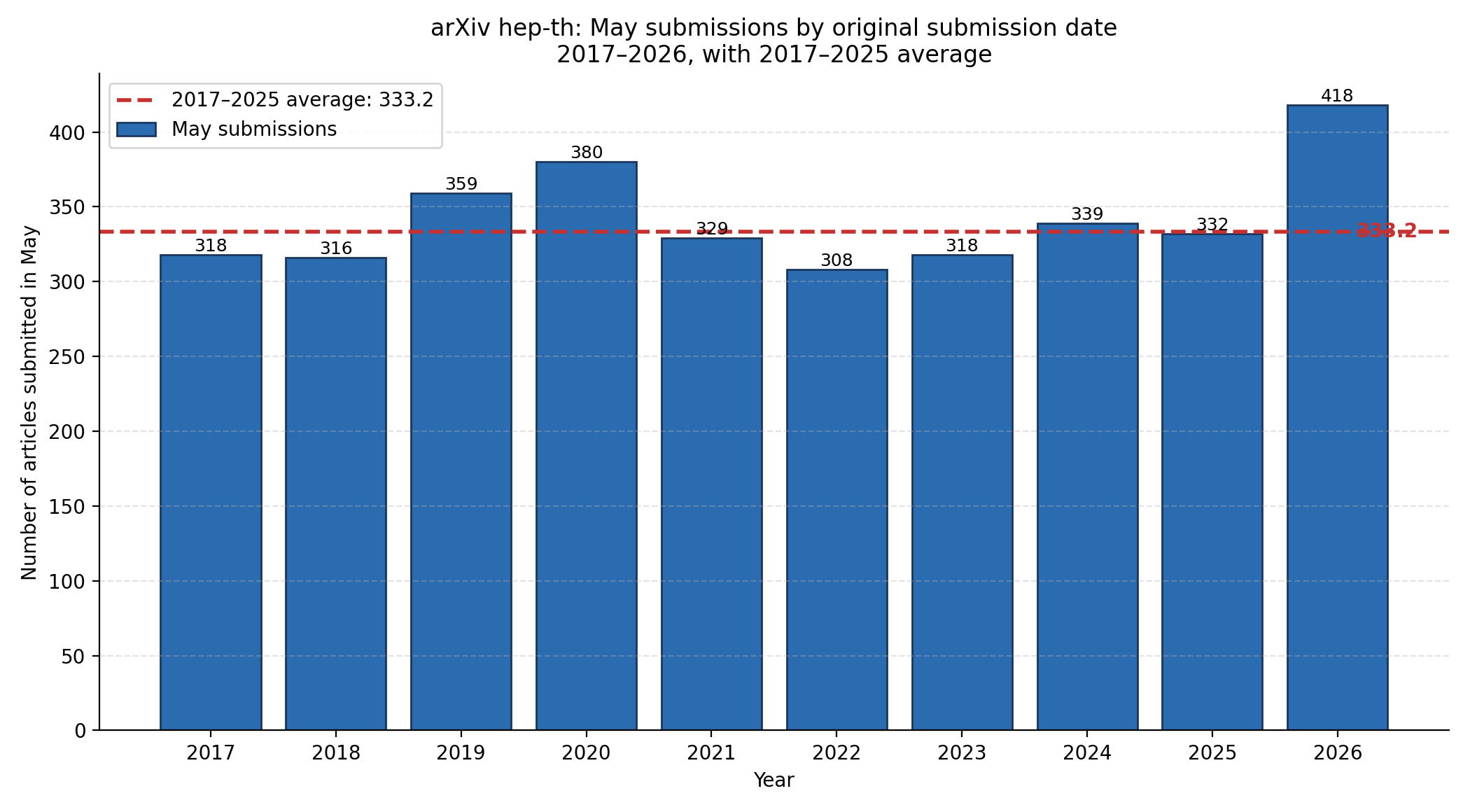
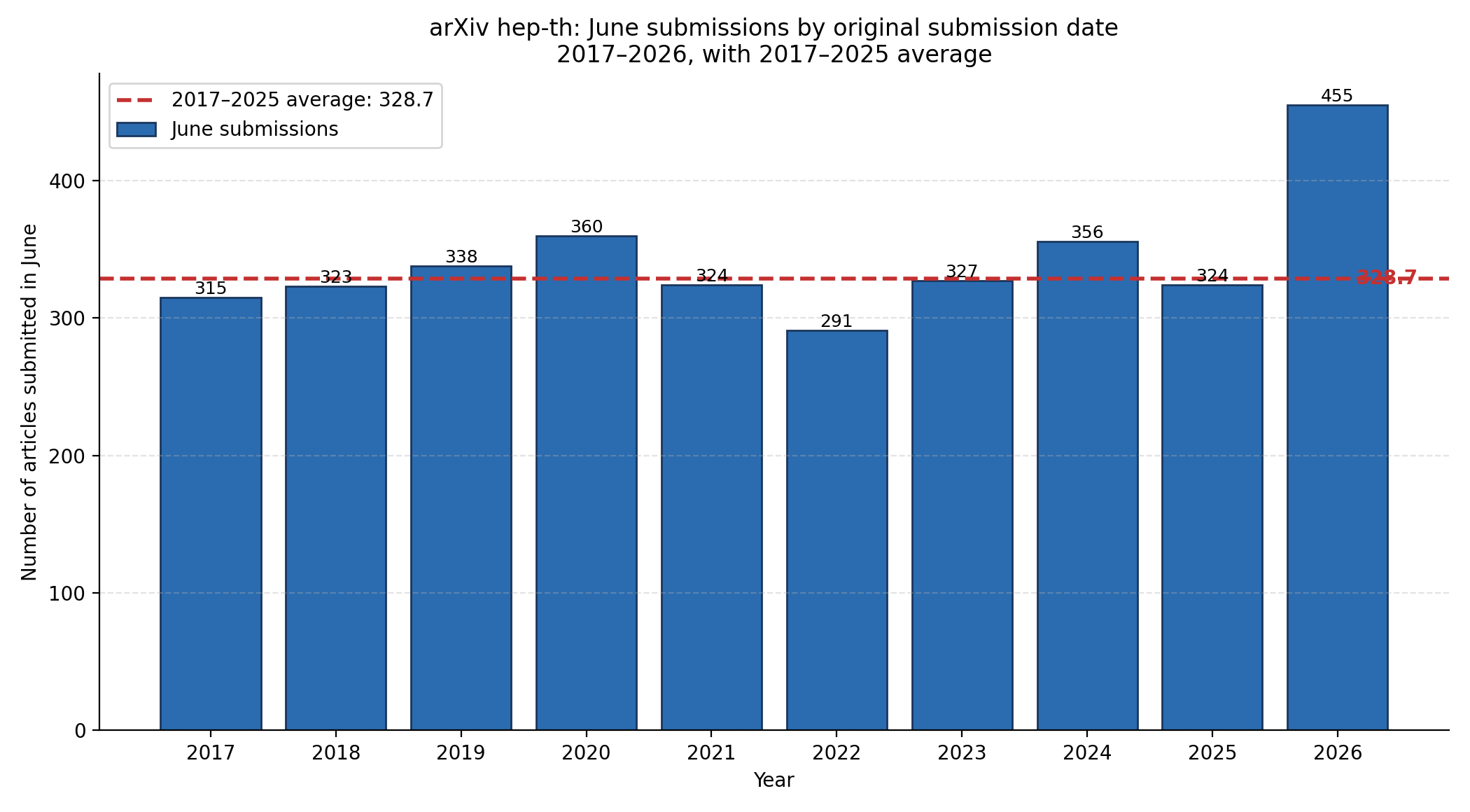
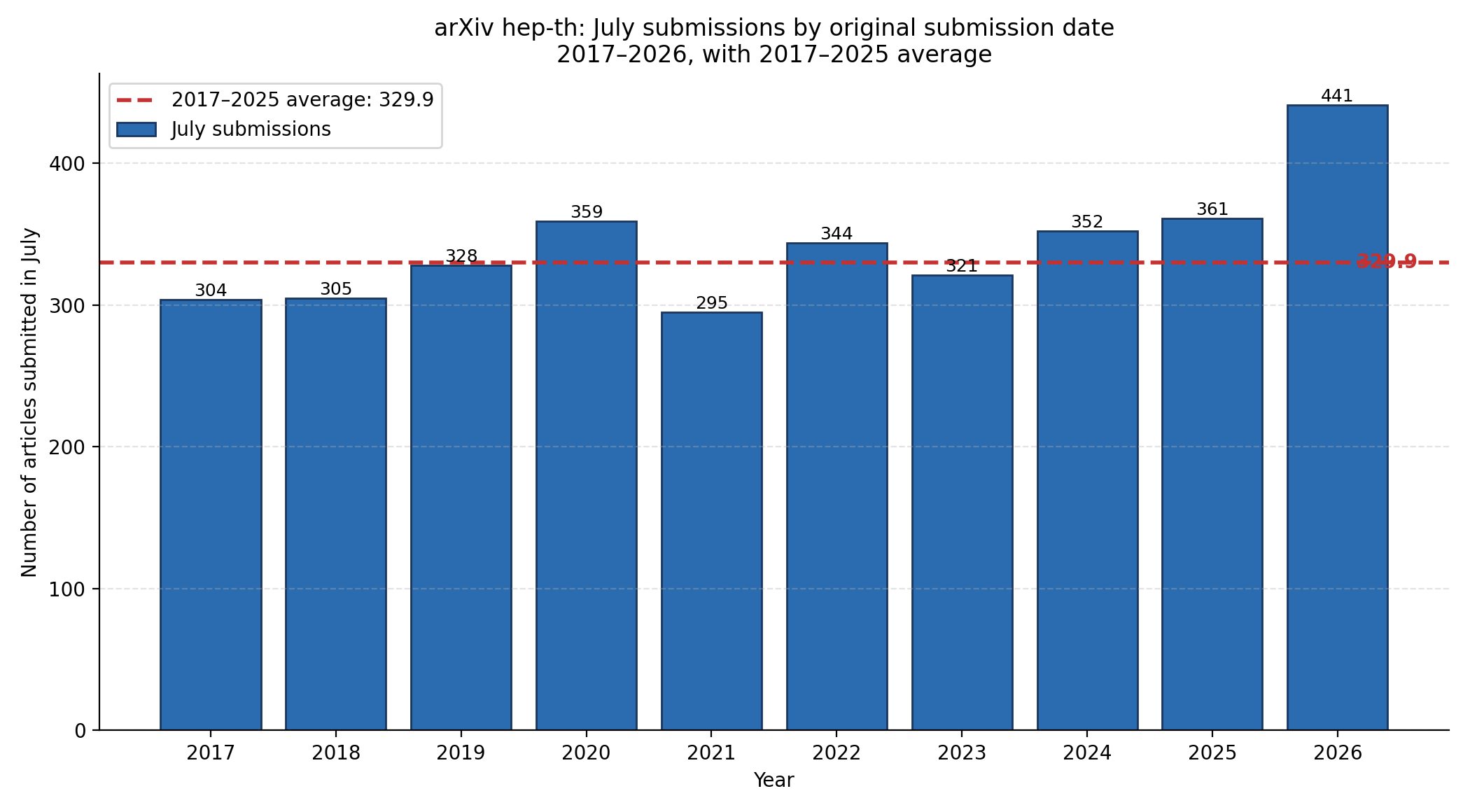
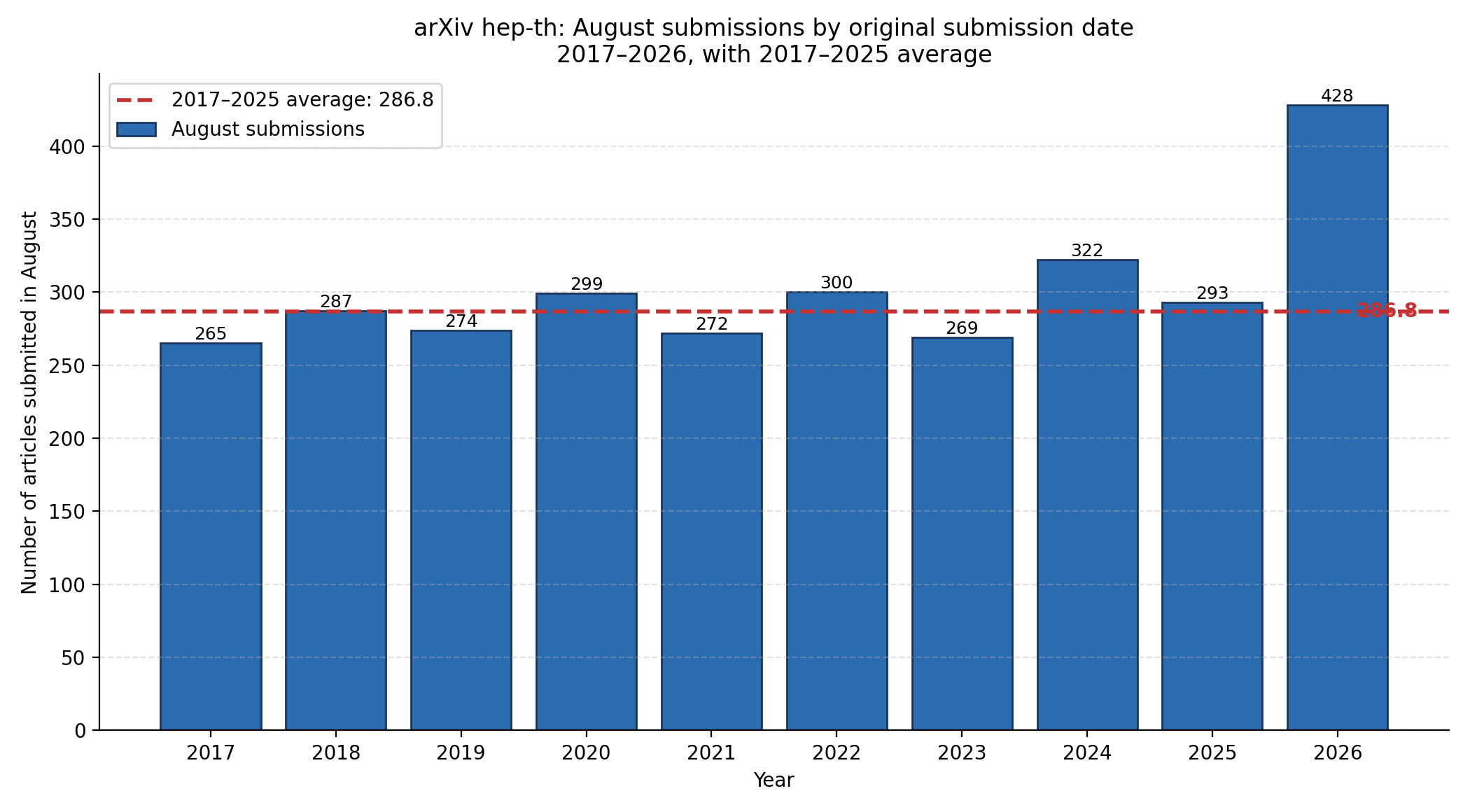
Update: Sorry, but a commenter points out that this may just be an artifact of counting based on when most recently modified, not on original submission date.

Numbers using original, not most recent, submission dates

For 12/1 to 12/31 the numbers were
2022: 800
2023: 811
2024: 815
2025: 855

For 1/1 to 2/1
2022:510
2023:490
2024:501
2025:544
2026:617

For 2/1 to 2/15
2022:255
2023:221
2024:280
2025:276
2026:311

These do show significant increases year to year for the last couple months, but not the near doubling indicated by the other numbers. The hep-th arxiv apocalypse is not here yet.

For a while now I’ve been speculating about what would happen when AI agents started being able to write papers indistinguishable in quality from those that have been typical of the sad state of hep-th for quite a while. Sabine Hossenfelder today has AI Is Bringing “The End of Theory”, in which she gives her cynical take that the past system of grant-holding PIs using grad students/postdocs to produce lots of mediocre papers with the PI’s name on them is about to change dramatically. Once AI agents can produce mediocre papers much more quickly than the grad students/postdocs, then anyone can play and we’ll get flooded by such papers from not just those PIs, but everyone else.

I decided to take a look at the arXiv hep-th submissions, and quickly generated the following numbers, by simple searches using
https://arxiv.org/search/advanced
to find all hep-th submissions in various date ranges.

For 12/1 to 12/31 the numbers were
2022: 634
2023: 684
2024: 780
2025: 1192

For 1/1 to 2/1
2022:583
2023:531
2024:626
2025:659
2026:1137

For 2/1 to 2/15
2022:299
2023:266
2024:271
2025:333
2026:581

From this very limited data it looks like submission numbers in the last couple months have nearly doubled with respect to the stable numbers of previous years.

I thought about spending more time I don’t have lookng into this, then realized “this is a job for AI!”. Surely an AI agent could do a lot better job than me in gathering such data, figuring out things like whether you can recognize the AI agent papers or not, and writing up a detailed analysis. I’m still resisting learning how to use AI agents, so someone else will have to do this.

One of my main problems with the comments here has been that it’s increasingly hard to tell the difference between human and AI generated ones. In this case, maybe the AI generated ones would be better than those from meatspace. So, unless you have something really substantive (like an explanation for why these numbers don’t mean what it looks like they mean, or know what the arXiv is doing about this) please resist commenting. I’ll moderate comments for things like irrelevance and hallucinations, but won’t delete comments just because they are non-human.

Posted in Uncategorized | 18 Comments

Osterwalder-Schrader

I’ve been trying to write up some new ideas about Wick rotation for a long time now, keep getting stuck as it becomes clear at various points that I haven’t gotten to the bottom of what is going on. To take a little break from that I thought it might be useful to write some more informal things here on the blog, about parts of this story that I do understand.

One thing I want to write about are two important papers by Konrad Osterwalder and Robert Schrader. The first is their Axioms for Euclidean Green’s Functions, published in Communications in Mathematical Physics in 1973. I’ll refer to this as the OS reconstruction paper. The second is Euclidean Fermi fields and a Feynman-Kac formula for Boson-Fermion models, published in Helvetica Physica Acta, also in 1973, which I’ll refer to as the Euclidean Fermi fields paper.

Konrad Osterwalder was the instructor in my Math 55 class at Harvard, my first semester there in the fall of 1975. I just found out while looking for some information about him that he passed away quite recently (December 19 last year). Back in 1975 Osterwalder was an assistant professor in mathematical physics at Harvard, and the Math 55 class he taught followed quite closely chapters 0-4 of Loomis and Sternberg’s Advanced Calculus, which at the time was the standard textbook for the course.

During my last term at Harvard (spring 1979) I took an upper level graduate class from Arthur Jaffe on the foundations of QFT. As a requirement of the course, I had to pick a relevant paper and write about it. The paper I picked was the Osterwalder-Schrader Euclidean Fermi fields paper. I was pretty much mystified by it, and remained so for many, many years. I’m planning to write something about this paper in a later blog post, here will concentrate on the OS reconstruction paper.

For some amusing commentary on the story of the OS reconstruction paper, see Slava Rychkov’s talk “CFT Osterwalder Schrader Theorem” at this meeting in 2019, where he says:

these papers appeared in Communications in Mathematical Physics. If you start reading these papers you immediately get a headache. The first ten pages are just notation. You have to go through then another theorem, lemma, lemma theorem, Hille-Yosida theorem, things like that.

Very few people have read these papers and very few people know what has actually been done there. It’s almost irresistible, people love to cite these papers because it’s like a feeling of ancient magic books, the scriptures. Many normally very careful people misquote these papers and miscite them by attributing to them results which are not there.

The background for all of this is the story of Euclidean or imaginary time quantum field theory, which starts with Julian Schwinger’s 1958 paper On the Euclidean Structure of Relativistic Field Theory. For some relevant history, see here. One way of looking at quantum field theory is that it’s all about the vacuum expectation values of field operators, the Wightman functions. What Schwinger was suggesting was that one could define quantum field theories in terms of the analytic continuation of Wightman functions, evaluated at imaginary time (these are now known as Schwinger functions). This fits well with the modern point of view that QFTs should be defined by path integrals, since it is only imaginary time path integrals for which one can hope to have something one can make rigorous, not a purely formal object.

Schwinger was well aware that if you tried to define a QFT as a set of Schwinger functions, something missing was a way of recognizing when these corresponded to a physical theory in real time. In the discussion session of his presentation at the 1958 ICHEP, he said

The question of to what extent you can go backwards, remains unanswered, i.e. if one begins with an arbitrary Euclidean theory and one asks: when do you get a sensible Lorentz theory? This I do not know. The development has been in one direction only: the possibility of future progress comes from the examination of the reverse direction, and this is completely open.

The OS reconstruction paper was based on a crucial new idea for how to recognize a Schwinger function corresponding to a physical real-time theory, the condition of “reflection positivity”. Jaffe recounts here how this came about.

A crucial property for a quantum theory is that it has a Hermitian inner product on states, with states having positive norm in this inner product. The Hermitian nature of the inner product of two state vectors involves complex conjugation on one of them. On functions of time, this is just complex conjugation of the value of the function. When you work with complex time $z=t+i\tau$ instead of real time, the complex conjugation takes $z=t+i\tau$ to $\overline z=t-i\tau$. This is a reflection $\tau \rightarrow -\tau$ in the imaginary time axis, sometimes called the Osterwalder-Schrader reflection.

By the way, this seems to me a first indication of the possibility I’ve been trying to understand of spacetime transformations in Euclidean spacetime turning into internal symmetries in Minkowski spacetime (here reflection in time is turning into pointwise complex conjugation).

What Osterwalder and Schrader did in the OS reconstruction paper was provide a theorem stating when Schwinger functions came from Wightman functions. As Rychkov notes, this paper is very hard going. After spending a lot of time with it, I realized one reason why the whole thing is difficult, which I’ll try and explain here. This is something that has held up what I’ve been trying to do with Wick rotation. Quite possibly I’m missing something and maybe someone will explain to me what it is.

Analytically continuing from real time to imaginary time is relatively easy, because it’s an example of what mathematicians know as the Paley-Wiener theorem. If you have a function $f(t)$ with Fourier transform $\widetilde f(E)$ that is only supported at positive energy, you can do inverse Fourier transformation to complex values of time by
$$F(z)=\frac{1}{\sqrt{2\pi}}\int_0^\infty e^{-izE}\widetilde f(E)dE$$
Because
$$e^{-izE}=e^{-itE}e^{\tau E}$$
this integral will give a result holomorphic in $z$ for $\tau<0$, with boundary value at $\tau=0$ the original function $f(t)$. The “Wick rotation” to a function of $\tau$ is given by $F(-i\tau)$. If you change the conventions I’m using for $2\pi$ factors and the sign of the exponent, this is just the Laplace transform of $\widetilde f(E)$
$$\int_0^\infty e^{-\tau E}\widetilde f(E)dE$$

The problem is that going in the other direction is much trickier. Given a function $f_S(\tau)$ (S for “Schwinger”), if you try to analytically continue to get $f(t)$ by first inverting the Laplace transform to get $\widetilde f(E)$ (then inverse Fourier to get $f(t)$), there’s a problem. When you look up the formula for inverse Laplace transform it basically says “first analytically continue to $f(t)$, then Fourier transform to get $\widetilde f(E)$.”

The argument in the OS reconstruction paper is tricky, partly because they can’t directly do this inverse Laplace transform. Instead, given $f_S(\tau)$, they define a function of $E$ by Laplace transform, but this function is not $\widetilde f(E)$ (does anyone know of a nice relation between them?), although it has properties they can use to prove their reconstruction theorem.

It turned out that the proof in the OS reconstruction paper was flawed. Their lemma 8.8 claimed to show that the way they were dealing with this problem for a single variable would continue to work for multiple variables, but this was wrong, with a counterexample soon found. They later wrote a second paper, which fixes the problem, but at the cost of a very difficult argument, and assuming a particular property of the Schwinger functions. The Rychkov talk linked to above explains that when he tried to understand the exact relationship between Euclidean and Minkowski in conformal field theory, he was shocked to realize that the OS reconstruction theorem did not apply, because there was no viable way of knowing if the Euclidean Schwinger functions had the necessary property. At this point, the best way to try and understand the OS reconstruction paper is not by reading it, but by looking at explanations from Rychkov (videos here and here, or section 9 of a paper with collaborators).

The OS reconstruction argument is an impressive and important piece of mathematical physics, but its impenetrability has had the unfortunate effect of convincing most people (myself included for many years…) that the relation between Minkowski and Euclidean quantum field theories is something straightforward and well-understood. This matches up with an equally unfortunate conviction that the problems of defining QFTs by path integrals are not serious, with Minkowski vs. Euclidean nothing but a different sprinkling of factors of i in an integral.

This story is just one aspect of fundamental problems about understanding QFTs which go much deeper than that of not being able to provide rigorous proofs. Already by the time I was a student it was clear there was a mismatch between the scalar QFTs studied by mathematical physicists using Euclidean methods and the ones relevant to the real world. In addition, the bottom line about such scalar QFTs turns out to be that they exist and are non-trivial only in two and three spacetime dimensions, must be trivial in four or more spacetime dimensions.

The Standard Model QFT is mainly built on spinor Fermi fields and Yang-Mills gauge fields. I’m sure that’s why back in 1979 I was interested in the Osterwalder-Schrader Fermi fields paper (much more about this in another blog posting). Attempts to fully understand Yang-Mills gauge fields soon moved to the discretized lattice gauge theory. During my graduate student years I was seduced by the simplicity of Euclidean spacetime pure Yang-Mills lattice gauge theory, which is basically a geometrically beautiful statistical mechanics system that can be studied with statistical mechanics methods, including straightforward Monte-Carlo calculations. That experience, coupled with not understanding the subtlety of the OS reconstruction theorem, left me convinced that the way to understand QFT was using path integrals in a Euclidean spacetime theory, with the question of the relation to physics just one of how to do the analytic continuation to real time after the theory was solved.

More and more I’ve become convinced that this was a misguided point of view. A better starting point may be the following. A fundamental aspect of quantum theory is the existence of the Hamiltonian H and a unitary operator $U(t)=e^{-itH}$ which represents translation in time and provides the dynamics of the theory. The significance of Wick rotation is that it is telling you that if you think of time as complex variable, positivity of the energy implies that $U(t)$ is only part of the story, a boundary value of a holomorphic representation $U(z)=e^{-izH}$ of a holomorphic semigroup (complex time translations with imaginary time one sign only). The fundamental quantum field theory of the real world likely should not be thought of as a statistical system, but as having a holomorphic aspect, involving much deeper mathematics.

Update: Glad to see a relevant comment from Yoh Tanimoto. In order to make clear exactly what is bothering me about the OS reconstruction argument and explain the comments about Laplace and inverse Laplace in the posting, here are some more details (I’m simplifying by ignoring spatial variables).

OS are getting Wightman distributions W from Schwinger functions S in 4.1. There in 4.12 they define the Fourier transform $\widetilde W$ as the unique thing whose Laplace transform is S. They do this by invoking the lemma 8.8 that gets them in trouble. If they had a formula for the inverse Laplace transform, explicitly giving $\widetilde W$ in terms of S, they wouldn’t have trouble.

What’s really bothering me is what they do in section 4.3 (which, besides being a complicated argument, is atrociously written, hard to decode). There they are trying to show that the following constructions of the physical state space are the same:

  • Euclidean construction $\mathcal K$ as test functions on the positive imaginary time line modulo those null in the inner product given by $S$ with the OS reflection.
  • Usual Wightman real time reconstruction of the state space $\mathcal H$ as test functions of real time modulo those null in the inner product given by W.

Here the problematic Laplace transform is that of equation 4.20. They Laplace transform (NOT inverse Laplace transform) the first kind of test function to get the Fourier transform of the second kind of test function. I guess they are able to get an identification of the two Hilbert spaces this way, but I’m wondering why you don’t instead use the inverse Laplace transform and be matching analytic continuations of the two kinds of test functions. Presumably because without a formula for the inverse Laplace transform you can’t match the norm using S with the norm using W.

To say a bit more about my motivation, it’s that I’d like to know why there’s not a more straightforward version of the Wick rotation between two different definitions of the physical state space. I’d like a holomorphic construction that specializes to the two different cases (have been trying to do this using hyperfunctions).

Posted in Uncategorized | 19 Comments

Weil Anima

Dustin Clausen is giving a course at the IHES starting today on “Weil Anima” (or maybe “Weil-Moore Anima”. They’ve already put up video of the talk here (also available on Youtube). For an earlier talk by Clausen on this material from last year, see “Refining Weil groups” at the Manin memorial conference.

I just watched the IHES Clausen talk, which was a mind-blowing experience, highly recommended if you’ve been following this subject in recent years. Unfortunately I can’t do any sort of justice here to the sweep of fascinating new ideas about math at its deepest level that the talk covers, mainly because of lack of competence, but also because of lack of time.

Trying to find time to think about the talk clarified for me the current state of my intellectual life. Thinking about the larger world (or even the local world outside my office window…) has become thoroughly depressing. I really should stop following the news in any form to preserve my mental health. This argues for concentrating on thinking about the problems in math, physics and their overlap that I’d most like to understand better.

As far as deep ideas about physics goes, paying attention to what’s been going on in the subject long ago became depressing. The situation in mathematics is completely different, with Scholze, Clausen and many others making dramatic progress towards unearthing a wonderful world of new structure at the deepest level in mathematics. A big problem is that this is intellectually extremely challenging material to follow, and I don’t right now have the necessary time. Besides the Clausen talks, this month there’s a program in Marseilles on Langlands-related stuff, with videos starting to appear that would doubtless be helpful if I had the time to watch them.

I’m trying to get the details of a new way of thinking about Wick rotation written down, and to make progress on that is a full-time effort. It’s rewarding in its own way, as I’m learning new things, but it’s extremely slow, spending most of the time stuck on trying to understand things like where signs come from. Learning beautiful new ideas that someone much more industrious spent years slogging through trying to get straight is a lot more appealing.

Finally, as a long-term goal, there’s the tantalizing fact that the twistor line plays a central role in the new ideas Clausen is talking about, and at the same time it plays a central role (as a point of space-time) in what I’ve been trying to do. That deep ideas about physics and about mathematics are closely linked is something I firmly believe, so I don’t think these two very different contexts for the twistor line have nothing to do with each other. I’d love to be thinking more about this, but need to stop blogging and get back to getting the Wick rotation paper finished…

Posted in Langlands | 1 Comment

The Epstein Files

Like millions of people, I couldn’t stop myself from spending a fair amount of time recently doing searches here, where one can read endless emails, texts, etc. showing in detail what Jeffrey Epstein was up to over many years. I was unsure whether to write anything about this here, but finally, this blog comment convinced me to write the following.

Epstein used his mysteriously acquired wealth to pursue his two great interests in life: the sexual exploitation of young women and hanging out with celebrity scientists. You can read all about both in the files in the database. While doing this, you’ll find a large number of prominent physicists and mathematicians making an appearance (you’ll also find my name there, in two emails from John Brockman to a large number of people. No, I never met Epstein or had any contact with him).

Epstein spent a lot of time having his assistants contact scientists and arrange meetings with them. If you were of sufficient interest, you’d get invited to dinner parties at his mansion with other celebrities, and have prospects dangled in front of you of financial support for your research. The contacts with Brian Greene linked to in the comment mentioned above were typical of this kind of thing. Like many other scientists, Brian appears to have agreed to meet with Epstein, in his case quite possibly as part of his fund-raising for the World Science Festival, but had little contact with him besides that. For another detailed description of how this kind of thing went, see Scott Aaronson’s latest posting. Scott had the advantage of advice from a very wise mother:

“be careful not to get sucked up in the slime-machine going on here! Since you don’t care that much about money, they can’t buy you at least.”

Lots of scientists and others did get sucked up in the slime-machine, to varying degrees. As far as I can tell, very few such scientists had any contact with Epstein’s massive sexual exploitation operation (although arguably they should have been aware of it from press accounts).

A lot of Epstein’s focus was on Harvard, with a large number of emails detailing his efforts to arrange meetings there, often holding out promises of potential financial support for research. Back in 2020 Harvard conducted its own investigation of what had happened, see here. The Harvard Crimson has been reporting on what the newly available files show about the Harvard connection, see for example here and here.

Sorry, but I’m not willing to moderate a discussion here of Epstein and his slime-machine. If you’re interested in the topic, the Department of Justice website is an inexhaustible source of disturbing information.

Posted in Uncategorized | Leave a comment

Various and Sundry

For now, a math item and a physics item, maybe more later…

  • Four years ago, after the decision to have the 2026 ICM in the US was announced, I wrote:

    With the 2022 experience in mind, hopefully the IMU will for next time have prepared a plan for what to do in case they again end up having a host country with a collapsed democracy being run by a dangerous autocrat.

    We’re very much in that situation now, and as far as I can tell the IMU is still planning for a normal, in-person event this July in Philadelphia.

    The French mathematical society (SMF) announced yesterday that they would not participate (in the sense of not having a presence such as a booth) in the ICM this year. I’m hearing that other national math societies have taken or are considering similar action.

    Setting aside the problem of lots of people for good reason not wanting anything to do with travel to the US right now, even those who do want to come here are facing serious problems getting a visa, in particular not being able to even get an appointment for a visa interview at this time.

    The murders and Gestapo tactics now going on in Minneapolis surely influenced the SMF decision and may cause people now planning on attending the ICM to change their plans. The nightmare scenario for ICM organizers is having ICE and its thuggery move on to Philadelphia, which unfortunately seems possible.

  • Natalie Wolchover has a very good article at Quanta with the title Is Particle Physics Dead, Dying or Just Hard? Where I come down on the question is that fundamental theory is all of the above (Hard, Dead, and Dying).

    Some of the themes she covers were ones I was trying to write about already 20 years ago here in the blog and in my book. A major theme of that book was that, in retrospect, the Standard Model that fell into place in 1973 turned out to be spectacularly successful: everything that it predicted turned out to be exactly what was measured, and no “new physics” that it doesn’t describe has turned up (beyond the minor addition of neutrino mass terms). So, in 1973 all of sudden, finding something fundamentally new in particle theory became very hard (the experimentalists had lots of challenging work to do exploring the 1 GeV to 1 TeV mass range, checking that what the SM predicted was there and nothing else was).

    The crisis that developed in fundamental theory was not just that it had become hard, with new progress a difficult, long-term effort. It’s that the field could not change its way of doing business to accommodate this. Instead of encouraging a long-term effort to attack the remaining fundamental problems, what was rewarded was pursuit of easy but wrong ideas that were coupled with an efficient hype machine. The path from GUTs to SUSY GUTS to compactified superstrings to the landscape was a path from one bad idea which could generate lots of papers to more and more complicated and ugly versions, finally reaching an endpoint 20 years ago of a completely empty and worthless research program (the “anthropic landscape”). Once the leaders of the field announced that their ideas were not wrong, just untestable, that part of the field died. It has now been dead for quite a while. These same leaders steadfastly refuse to acknowledge this, which is very weird.

    What’s happened over the past 20 years is that the intellectual death of the heavily promoted part of the subject started to become very clear to most people, including physicists in other fields, Deans, NSF and private foundation program officers. The field has been dying as good students don’t go into it, physics departments don’t hire in it, and granting agencies don’t fund it.

    Among those still with a job, most quietly have abandoned work on the well-known and failed ideas, and are trying to work on something more sensible. This is not easy: you’re not allowed to say that heavily hyped ideas were wrong and must be abandoned, have to try and find a way to do really hard work in an era of declining resources, with the PR machine for failed ideas (or new, worse ones…) trying to attract as much as possible of what’s left.

    Taking up all the remaining oxygen in the room right now is AI hype, exemplified by Jared Kaplan, who is quoted in the article:

    I spoke to Jared Kaplan, co-founder of Anthropic, the company behind the chatbot Claude. He was a physicist the last time we spoke. As a grad student at Harvard in the 2000s, he worked with the renowned theorist Nima Arkani-Hamed to open up the new directions in amplitude research that are being actively pursued today. But Kaplan left the field in 2019. “I started working on AI because it seemed plausible to me that … AI was going to make progress faster than almost any field in science historically,” he said. AI would be “the most important thing to happen while we’re alive, maybe one of the most important things to happen in the history of science. And so it seemed obvious that I should work on it.”

    As for the future of particle physics, AI makes worrying about it now rather pointless, in Kaplan’s view. “I think that it’s kind of irrelevant what we plan on a 10-year timescale, because if we’re building a collider in 10 years, AI will be building the collider; humans won’t be building it. I would give like a 50% chance that in two or three years, theoretical physicists will mostly be replaced with AI. Brilliant people like Nima Arkani-Hamed or Ed Witten, AI will be generating papers that are as good as their papers pretty autonomously. … So planning beyond this couple-year timescale isn’t really something I think about very much.”

    While I find it highly likely that AI agents can do as well or better at writing the kind of bad theory papers that have dominated the literature for a long time, it seems much less likely that they can write the sort of inspired papers Witten was writing at the height of his powers (e.g. Chern-Simons-Witten, that won him a Fields medal). Since Kaplan tells me that they’ll be doing this in a couple years, not much reason to think about and debate the issue now, we’ll see soon enough.

    Whether or not AI is the way to make progress, right now it’s certainly the way to get paid.

Posted in Uncategorized | 7 Comments

The Situation at Columbia (and elsewhere) XXXVI

Since I’m today seeing some reasons for not being completely depressed about the future, locally and globally, some comments on the latest news.

The Columbia trustees announced today the appointment of Jennifer Mnookin, the chancellor of the University of Wisconsin-Madison, as the next president of Columbia. Given the past behavior of the trustees I had been pessimistic about who would want this job and who they would pick, but from all indications, Mnookin seems like a good choice (there’s a statement from her here). I’m cautiously optimistic that she’s coming in with an agenda of turning away from the trustee’s policy over the last year of caving in to dictatorial illegality, repressing dissent and promoting bogus accusations of antisemitism in order to placate the Trump administration.

It will take quite a while to overcome the shameful reputation that Columbia has acquired due to the actions of the trustees. One early thing to watch for is whether Mnookin will maintain the current locked gate policy supposedly keeping us “safe”, or return to an open campus.

Less locally, more people are starting to realize that Yes, It’s Fascism. The people of Minneapolis are providing an inspirational example of what effective resistance to Fascism looks like. When you effectively challenge Fascists they start shooting you. Renee Good and Alex Pretti paid with their lives for their willingness to resist.

So far, it seems that these outrageous murders and the obvious lies about them in the face of overwhelming video evidence are having an effect. Even Rupert Murdoch’s Wall Street Journal and New York Post have editorials criticizing ICE and the Trump administration. Stephen Miller and the other Fascists now in control of the government are facing a decision: back down or keep going. If they continue what they are doing or double down, the resistance movement in Minneapolis will hopefully keep up the fight. Everyone should help with this in any way they can.

The situation has gotten so extreme that even Barack Obama and Bill Clinton have issued condemnatory statements. The only valid criticism that Trump and his people have been able to make about their latest murder victim is that he was guilty of bringing a gun to a protest, but this is just going to split their base in which gun fanatics are heavily represented.

The question now in the US is not whether we have a Fascist regime, but that of how successful it will be in burying democracy and defeating any opposition. One ongoing problem is that many influential groups in the US have found that they can get what they want by going along with Trump. Two examples are our new class of collaborationist oligarchs and those intensely devoted to the genocide in Gaza (Scott Aaronson explains here that Trump is still valuable and necessary to stop people from calling him “genocidal”).

The trustees of Columbia last year decided that the right thing to do when confronted by Fascist power and those collaborating with it was to give in and leave resistance to others (e.g. Harvard). All institutions in the US and elsewhere need to step up now and resist Fascism as much as they can. Perhaps naively, I’m hoping that my institution is now turning towards that path.

Posted in The Situation at Columbia | 8 Comments

This Week’s Hype

The string theory hype machine will never die. This week we have

I’ve been documenting this sort of ridiculous hype for more than twenty years now. It has done a huge amount of damage to the public understanding of science and to the credibility of scientists. It also hasn’t helped the perception of string theory by other physicists, with string theorists now virtually unemployable unless they can figure out how to rebrand as machine learning experts. String theorist Manki Kim reports here that “string theory is in a very fast contracting phase, maybe I was dumb enough to hold on to a dead horse for too long. Should’ve given up long time ago.”

There’s no point in going into more detail about this kind of hype and its continued existence. The world is passing it by, moving on to fresh, new horrors.

Posted in This Week's Hype | 33 Comments

Approaching 50 Years of String Theory

Brian Greene has a new video out today, of himself talking to Edward Witten, mainly about string theory. Pretty much the usual decades-old hype, with nothing even slightly different than what a similar conversation would have consisted of 20 years ago.

Of historical and psychological interest, Witten explains that when the anthropic landscape nonsense arrived, it made him uncomfortable and unhappy:

I was very upset. It really got me disturbed. First of all, well, as a physicist, I wanted to explain the masses and lifetimes of the elementary particles and other properties, rather than accepting the fact that they depended upon the choice of a classical solution. Literally, it made me very unhappy for years. I made my peace with it because I had no alternative. So I made my peace with it by accepting the fact that the universe wasn’t created for our convenience and understanding it…

So I accepted that. I came to accept that, I would say, by now almost 20 years ago, roughly 20 years ago. And I’ve had a more peaceful life since then…

At the time I saw the “landscape” as something that would finally cause leaders of the field like Witten to admit that string theory wasn’t working and to hopefully move on to something else more promising. Surely he would not follow Susskind and some others down this obviously unscientific path. He explains here that facing the failure of his dreams “made me very unhappy for years”. He could have admitted failure, but that would lead to ongoing unhappiness. If he wanted to avoid admitting failure, he had no alternative.

String theory and string theorists like Greene and Witten more than 20 years ago reached a dead end. They were much younger then and one could have imagined a new beginning of a more promising direction. At this point though, any hope of that is long gone. They’ve long ago decided that they had “no alternative” but to spend the rest of their days repeating the same hype that had inspired them in their youth.

Greene does at one point refer to critiques of string theory, while dismissing these with the rather nasty ad hominem characterization of “the chatter of people who may have other agendas”. Unfortunately this conversation is largely the chatter of two people with a shared agenda, that of continuing to prop up a failed idea they are heavily invested in.

Posted in This Week's Hype | 10 Comments