Requiem for a Field?

Kevin Hartnett posted the following Friday:

My profile of @Jacob_Tsimerman, published the morning he won the Fields Medal, and hours before he announced he’s going to @OpenAI, reads like a requiem for a field.

While I’m trying to not spend too much time thinking about the ongoing story of the effect of AI agents on math, the story of Jacob Tsimerman’s Fields medal award coinciding with his announcement that he’s leaving research math to go work of OpenAI is hard to ignore. If you do want to spend time thinking about the implications of this, it’s worth reading the profiles at the New York Times as well as Hartnett’s at Quanta Magazine. Also very much worth reading is Tsimerman’s own explanation (in an exchange with Daniel Litt) of how he sees things. This was written before the OpenAI announcement, but goes a ways towards explaining Tsimerman’s decision.

A few personal comments: I’ve never had any interest in the kind of problem-solving Tsimerman specializes in, so have no idea if he’s right that humans will no longer be able to compete with the AI agents in this area within the next few years. His current situation makes him a very special case. In the Quanta profile he explains that he quit math competitions once he got a perfect score at the 2004 IMO, figuring it best to stop at the top of his game. Winning a Fields medal puts one in an analogous situation professionally: there are lots more awards you could get, but that’s the big one.

In addition, while a Fields medal comes with academic job offers that allow one to do whatever one wants and be very well-paid to do it, our tech overlords at OpenAI can and do pay a great deal more.

Finally, if you’re the competitive sort, what’s happening is making competitive problem solving much less attractive. It’s not just that the AI agents may beat you, it’s that the game is now being played very differently. When you’re competing against other mathematicians, there are strong norms about crediting ideas to those who came up with them, something that AI agents have no interest in doing. The situation isn’t quite like the situation in chess, where powerful chess programs got to the point they could beat humans, but human to human chess competition survived. Where we’re going could be analogous to chess playing where everyone is using, with or without acknowledging it, some sort of chess program. “Winning” at this will be something very different than pre-AI.

My own interests are quite different than Tsimerman’s. Math competitions never had any appeal to me. This was partly because I’ve never been competitive or much interested in “winning” anything. Also, why spend time on intricate math problems chosen mainly because they could be expressed in elementary terms and solved by elementary methods when there is so much beautiful and powerful non-elementary mathematics to learn about? As one learns mathematics there are always new depths to explore, and these depths seem to contain unexpected ideas that explain what is going on in fundamental theoretical physics, a subject with its own challenging depths to explore. So far I haven’t seen AI agents doing anything new and important that I would care about, but maybe that’s just a matter of time…

Update: Timothy Gowers (another Fields medalist and IMO winner with a perfect score) has a long blog post with his thought about the Leiden declaration at his blog.

Posted in Uncategorized | 13 Comments

Various and Sundry

Some things that might be of interest:

  • The ICM is starting next week in Philadelphia. One traditional aspect of the ICM is the announcement of the Fields Medal winners. This year there won’t be much surprise, since evidently someone found the names of the winners hidden in the website code (see here, English language news story here). It’s Yu Deng, John Pardon, Jacob Tsimerman, and Hong Wang. At least all science journalists who want to write about this now know the names, no controversies about who has embargoed information as in some past years.
  • Strings 2026 was held last week in Shanghai. Looking through the talks (see here, videos here), I see nothing that looks like a significant new idea or any evidence this isn’t a dead field. I watched the public talk by David Gross, which was just bizarre. Much the same talk Gross has been giving for thirty years about string theory unification, with no indication there’s any problem with the idea. For detailed discussion of a similar talk 22 years ago, see here. The main difference with that talk is that Gross removed all the slides about how SUSY was about to be found and would vindicate string theory. Gross argues against the “landscape”, saying that he thinks there will be some new insight explaining how all the constants of nature emerge from understanding the big bang, but this seems to be backed by nothing except wishful thinking.

    Gross started off the talk by complaining that he had had to work hard for the few days before his talk, since he had found that his slides were so old that the file formats now had compatibility problems with current software. I’m completely baffled by how anyone involved in this could think that going to the public with this sort of thing is a good idea.

    Also on the Strings 2026 topic, Stringking42069 is back.

  • Every so often I think it’s worthwhile to point to something about the “interpretation” of quantum mechanics that reflects my best understanding of the subject, so see here.
  • Quanta magazine a while back had a good article about the deep new mathematics being develop by Peter Scholze, Dustin Clausen and others. Clausen has a paper out on the Weil-Moore Anima he was lecturing about at the IHES earlier in the year.
  • Finally, something inspirational: my Columbia colleague Joan Birman is still active at 99 years old, and has an important new result on the Burau representation. This is the result of a project that began when a high school student, Vasudha Bharathram, came to Birman for help in learning more math and finding a problem to work on. Bharathram will be a beginning Ph.D student at Princeton in fall. The third member of the collaboration is Tara Brendle, a student of Birman’s. This collaboration must break some sort of record in math research for the age range of the collaborators.

Update: For a new documentary series about Bourbaki, see here.

Update: As a commenter here noted, the LANA project to try and formalize the controversial part of Mochizuki’s supposed proof of abc has issued a report and held a press conference today. From watching the press conference and reading the report, my conclusion is that this has ended up exactly where one could have predicted. The LANA people have identified a precise gap in the argument (which for some reason they call a “wall” rather than a “gap”), at the point where Scholze and Stix in 2018 claimed there was a problem. The gap is where Mochizuki says two different things are the same, while LANA sees no argument for this to be the case, and hasn’t gotten one from Mochizuki, Yoshi or anyone else.

Since no one now has an argument (other than “it’s obvious”) that fixes the gap, it’s clear that what PRIMS published was not a proof, but a proof with a gap, and that the refereeing process failed in this case.

Update: The big AI news of the day is the discovery using an AI agent of a counter-example to the Jacobian conjecture. For some more about this, background, and discussion of a recent AI-found counterexample to a conjecture of Grothendieck’s, see today’s blog post by Kevin Buzzard: Human mathematicians are being outcounterexampled.

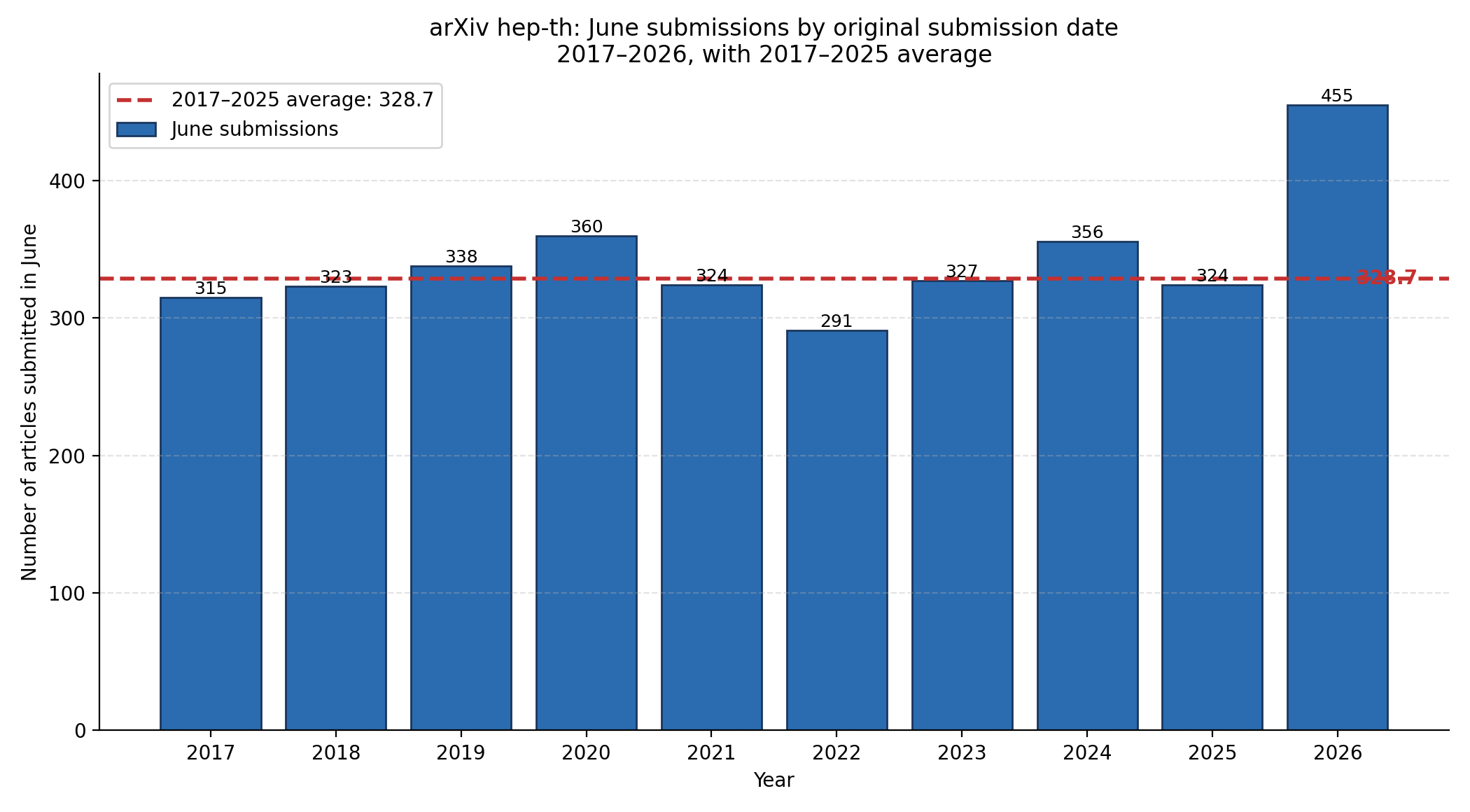
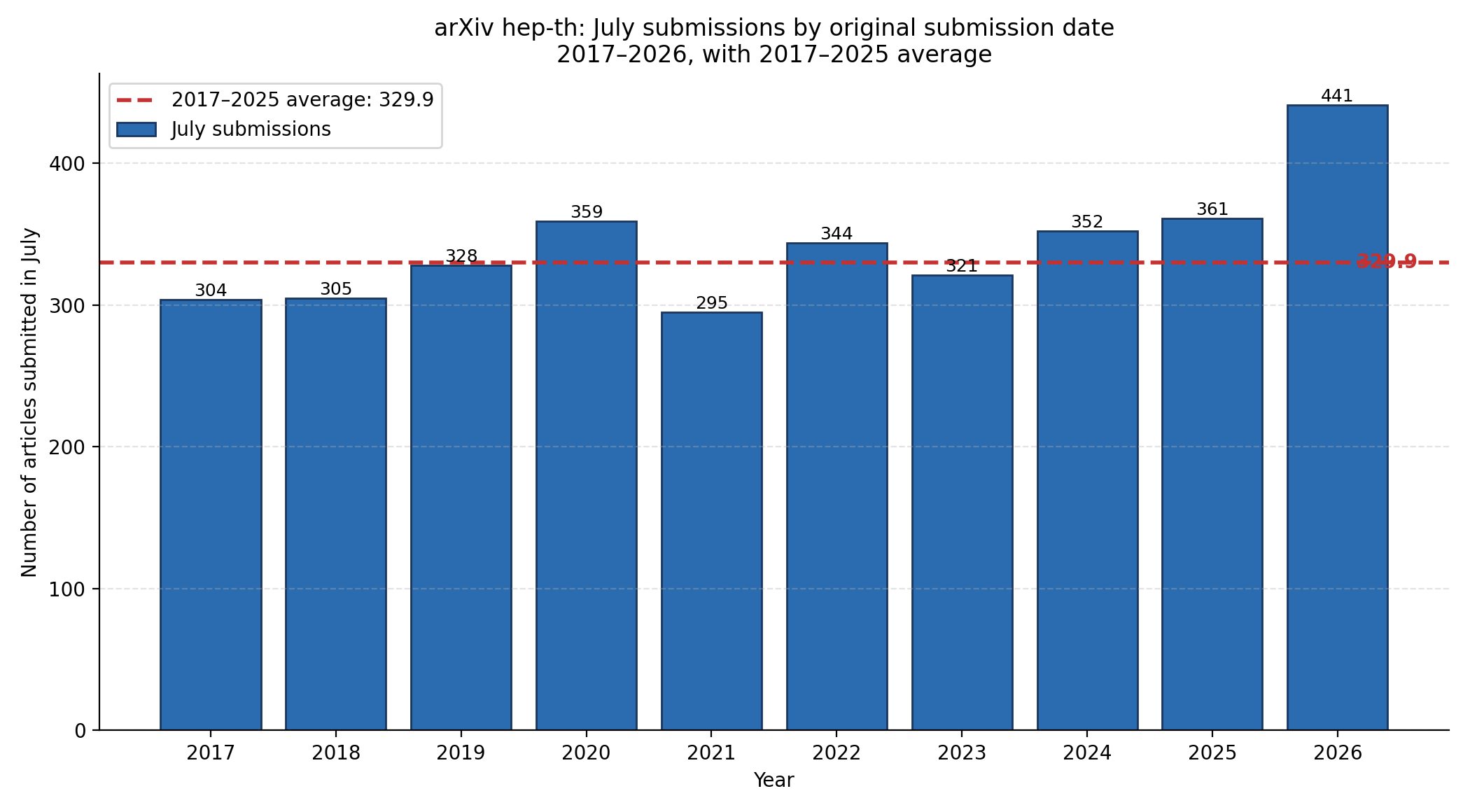
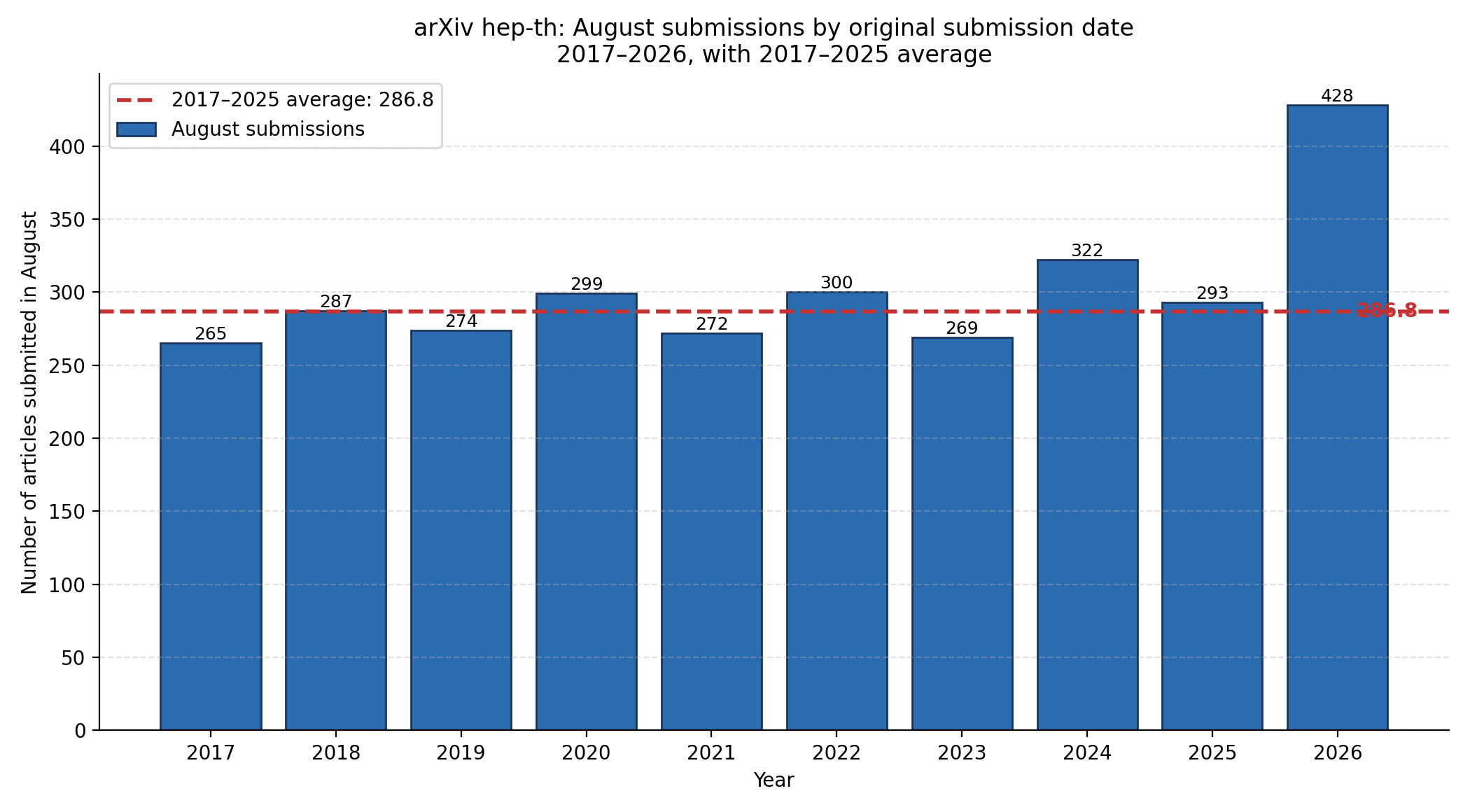
Update: While in mathematics AI agents are starting to have a major positive impact on research (e.g. by resolving the Jacobian conjecture), the situation is very different in hep-th. For an extreme example, see this paper from today. It claims to derive interesting statements about QFT from the counterexample to the Jacobian conjecture posted on twitter at 2:19 UTC yesterday, and was submitted to the arXiv less than 15 hours later (15:09 UTC). Obviously it was pretty much completely AI generated (and this is acknowledged in the text). The result is something completely worthless, but not obviously distinguishable from many other things on hep-th, which is in serious danger of going from something sad and unhealthy to something completely overwhelmed with crud.

The director of the arXiv’s reaction:

We’re having an acute and abrupt misalignment of incentives

Really worried we can’t adjust systematically rapidly enough to avoid some really badly disruptive intermediate states

That the problem for hep-th is just “badly disruptive intermediate states” seems to me an optimistic way of putting it…

Posted in abc Conjecture, Quantum Mechanics, Strings 2XXX, Uncategorized | 12 Comments

Notes on Wick Rotation and Chiral Field Theories

A few months ago I decided to try and sort out the two dimensional spacetime case of the Wick rotation issues that have been bothering me for years now. It took me a while to understand what goes on in two dimensions, but when I did, this clarified a lot for me the underlying problems with Wick rotation that I’ve been confused about. I’ve just finished writing something up about this, which you can find here.

Instead of writing more about this tonight, I’ll leave that for tomorrow. Will either write some more in the posting, or in the comments.

Posted in Euclidean Twistor Unification | 3 Comments

Complexifying the Complex

I’ve been working recently on trying to understand exactly how Wick rotation works in two-dimensional conformal field theory. There is an analog there of some of the issues with Wick rotation of spinors and twistors in four dimensions that I’ve been struggling with.

One of the few times I’ve tried to get help from an AI agent, I asked it to point me to discussions of this topic in the literature. It gave me a bunch of suggestions I already knew about, then emphasized that the two best places were a certain textbook and another set of lecture notes. Since I hadn’t heard of these, this was exciting news, so I immediately went to look them up. Hallucinations, they don’t exist.

In what I have been reading, I’ve repeatedly come up against what has become a pet peeve, related to the second pet peeve discussed here. In the 2d conformal field theory literature, one is continually told that one is dealing with functions of $z$ and $\overline z$, but $z$ is independent of $\overline z$. $\overline z$ appears to mean something that sometimes is the complex conjugate of $z$, sometimes unrelated to $z$. What’s really going on here???

What’s going on is that one needs to complexify something that is already complex. One can do this by thinking of the underlying real object and complexifying that. When you do this, you end up with a pair of complex objects, with a conjugation map that relates them.

If you start with a real vector space $V$, which also happens to come with a complex structure (a notion of how to multiply elements by $i$), then its complexification will be
$$V\otimes_{\mathbf R}\mathbf C=V \oplus \overline V$$
where $\overline V$ is a copy of $V$ with the opposite complex structure, and you have a map
$$\sigma : V\rightarrow \overline V$$
that satisfies $\sigma^2=1$ and is anti-linear
$$\sigma (cv)=\overline c \sigma (v)$$

Things get confusing once one has $V\oplus \overline V$ because one sometimes wants to think of $v\in V$ as the pair $(v,0)$, independent of things of the form $(0,v)$, but sometimes as pairs $(v,\sigma (v))$. The second interpretation is useful, because then $V\subset V\oplus \overline V$ as the set of fixed points of $\sigma$. $\sigma$ is the conjugation map on the complex vector space $V\oplus\overline V$, so its set of fixed points is the real subspace.

In my earlier pet peeve posting, I write about one example of this. Lie algebras in general are real vector spaces, and to study them, one often needs to complexify. Sometime this is straightforward, for instance
$$\mathfrak{sl}(2,\mathbf R)\otimes_{\mathbf R}\mathbf C=\mathfrak{sl}(2,\mathbf C)$$
sometimes a bit less so
$$\mathfrak{su}(2)\otimes_{\mathbf R}\mathbf C=\mathfrak{sl}(2,\mathbf C)$$
(Note that two different “real forms” have the same complexification).

If one wants to study a complex Lie algebra like $\mathfrak{sl}(2,\mathbf C)$, one often has to think of it as a real Lie algebra and complexify, finding
$$\mathfrak{sl}(2,\mathbf C)\otimes_{\mathbf R}\mathbf C=\mathfrak{sl}(2,\mathbf C)\oplus \overline{\mathfrak{sl}(2,\mathbf C)}$$
This comes up in the Wick rotation context, where $\mathfrak{sl}(2,\mathbf C)$ is the Lie algebra of the Lorentz group, and to Wick rotate to Euclidean spacetime, one is supposed to analytically continue in the complexification.

A second context in which this same problem appears is in the quantization of the harmonic oscillator. If one starts with a real oscillator degree of freedom (e.g. a real scalar field mode of momentum $\mathbf p$), quantization using annihilation and creation operators involves identifying the phase space $\mathbf R^2$ with $\mathbf C$ and then complexifying
$$\mathbf C\otimes_\mathbf R\mathbf C=\mathbf C \oplus \overline{\mathbf C}$$
with the first term in the sum corresponding to creation operators, the second to annihilation operators.

But what if you are dealing with a complex scalar field? Then the phase space of a momentum mode is $\mathbf C^2$ and when you complexify
$$ \mathbf C^2\otimes_\mathbf R\mathbf C=\mathbf C^2 \oplus \overline{\mathbf C^2}$$
You now have two kinds of creation operators and two kinds of annihilation operators. One can organize these into annihilation and creation operators for harmonic oscillator states of two kinds, related by conjugation. These are the particle and anti-particle states, which are distinct in the complex scalar field case, identified in the real scalar field case.

Finally getting to 2d conformal field theory, one sees the same kind of issue, but now not for vector spaces but for manifolds. One is looking at real two-dimensional space-time manifolds $\Sigma$ and would like to complexify to do Wick rotation. But it’s useful to start by thinking of $\Sigma$ as a complex manifold, a Riemann surface. So, again one faces the question of how to complexify something already complex.

This starts to get much trickier to make precise than the vector space case, but it does make sense to think of the complexification of the Riemann sphere as
$$S^2\times \overline {S^2}$$
where $\overline {S^2}$ is the Riemann sphere with the opposite complex structure to that of $S^2$. Then one has pairs of coordinates and is now in the situation where people start talking about coordinates $(z,\overline z)$ where $z$ and $\overline z$ are independent.

By the way, this corresponds to a nice two-dimensional analog of the 4d twistor story. There one looks at compactified, complexified spacetime, with the complex conformal group $SL(4,\mathbf C)=Spin(6,\mathbf C)$ acting, with real forms $Spin(4,2)$ in the Minkowski case, $Spin(5,1)$ in the Euclidean case and $Spin(3,3)$ in the split signature case. Here the 2d compactified, complexified spacetime is $S^2\times S^2$, with a global conformal group
$$SL(2,\mathbf C) \times SL(2,\mathbf C)$$
acting, one factor on each $S^2$ factor. The Minkowski real form is $SL(2,\mathbf R)\times SL(2,\mathbf R)$, the Euclidean real form is $SL(2,\mathbf C)$ and it is for this second real form that one is complexifying something complex.

For some more about this, see chapter 3 of Graeme Segal’s manuscript “The definition of conformal field theory”, where he discusses the infinite-dimensional conformal groups that appear, and his remarkable idea that one should take the complexification of $Diff(S^1)$ to be the semigroup of annuli.

Posted in Uncategorized | 13 Comments

The First AI QFT Textbook

The first surprise of this afternoon was finally finding an informed and sensible discussion of the implications of AI agents for hep-th research, in the form of a twitter thread by stringking42069.

The second was learning from the twitter thread about Xi Yin’s ongoing project to have GPT 5.5 write a QFT textbook under his supervision. The past week there had been rumors that he was hired by OpenAI. If he’s now on their payroll, what he’s getting paid to do presumably is this textbook, which is a very active ongoing project.

The current state of the textbook is at this github repository. I don’t see a pdf anywhere there, but you can get the tex files by cloning the repository with

git clone https://github.com/xiyin137/QFT

and then tex’ing

monograph/tex/main.tex

He’s working on this right now, with latest changes 6 minutes ago.  What I downloaded produced a 3527 page pdf document.

I’ve just skimmed through the thing, and it’s quite fascinating, raising a host of questions. This is clearly a work in progress, on its way to a document with tens of thousands of pages (or more…). Also, it’s undoubtedly the first of many such projects to come. I know from experience that writing a textbook is a huge effort, and AI agents very plausibly could take over a lot of the work. So, one set of questions is about what the future of textbooks, specifically QFT textbooks, will be.

The first obvious comment is that this document is useless as a “textbook”, in the sense of something one could use to learn the subject from. No one is going to learn QFT in any useful sense by trying to read these thousands of pages. Sections of it might be useful to experts in the same way that a badly-written research monograph is.

When I wrote a QM (and some elementary QFT) textbook, a big part of the experience was the following process. Starting from a certain conception in my mind of what the right way to think about a topic was, I’d start writing, and then after a while realize that there was a better, clearer way to think about the topic, so lots of material had to be thrown out or completely rewritten. Sometimes I came to this realization because things were getting too complicated and it became clear there was a simpler way. Sometimes the new insight came from getting stuck on a calculation: at one point, days spent chasing signs that wouldn’t match led to understanding that I was thinking about the dual of the vector space I should have been thinking about.

For an AI agent to be able to write a good textbook, I think it will need to somehow embody that kind of process: realizing when a line of exposition needs to be abandoned because there is a better way to describe what is really going on.

For a QFT textbook, a big set of issues is the unsolved problem of what the best way to think about QFT really is. Just going out to the current literature, grabbing what is there and then trying to rework it as a textbook/monograph, results in a huge, undigested mass of various inconsistent ways of thinking. This may be useful for making clearer to us what’s wrong with the current state of the field, but not useful for anyone who wants to better understand what is really going on.

In any case, I’m curious to see how this project evolves, as well as others like it that surely will come. Initially their role will likely be just to provide examples of what doesn’t work: AI agents fed millions of pages of crud will just produce more crud. Can they develop real insight about fundamental issues in theoretical physics, or can human beings with real insight turn them into useful tools for progress? I’ve no idea how that will play out in the long term. In the short term, I think what we’ll see is just more crud, often dressed up and sold to the public as innovation by the PR departments of our new tech oligarchies.

Update: While Xi Yin is showing us what you’ll get if you get your textbooks from AI, other sites like this are showing what you’ll get if you get your news from AI.

Update: An announcement at the QFT textbook project site says that the public version there has been frozen, further development moved somewhere else (unspecified).

Posted in Uncategorized | 16 Comments

The Only Game in Town

Warning: if you follow this blog, you’ve heard this many times before, so can move on to something more interesting now.

There’s a video conversation between Brian Greene and Lenny Susskind from last week here. At 44:02, Susskind has this to say:

One of the chief critics is a colleague of yours, I believe. And he is rather forcefully maintaining that string theory, until it can produce a success of the kind where you actually can produce a number and that number can be checked with experiment, that it doesn’t have any value.

The main reason for this post is just to reiterate that this is not what I think. The problem with string theory as a unified theory is not that it hasn’t made a tested prediction, but that it has made no predictions, of any kind. It’s very clear now that, as a theory of the real world it’s a speculative idea that just doesn’t work. As to whether it has “any value”, you have to first define what “string theory” is. Under some definitions there are things of value, under others not.

Susskind goes on to accurately explain that any well-defined version of string theory (which he calls “String theory”, capital S) definitely doesn’t correspond to the real world. But, he argues, maybe some new, unknown variant of String theory will work. According to him “It’s the only game in town” and “you have to see it through”.

Brian later asks him “Is there anything that you could imagine happening in the field that would convince you that this is time to put it away?” “Finding it mathematically inconsistent” comes up, but he has already said that this is about an unknown new idea that would make things work. “I don’t know the answer to that” is then his answer: nothing would convince him. About other approaches doing better: “I think both you and I probably don’t put a lot of stock in there.”

In case you haven’t seen this, something from a Kurt Vonnegut magazine piece:

A guy with the gambling sickness loses his shirt every night in a poker game. Somebody tells him that the game is crooked, rigged to send him to the poorhouse. And he says, haggardly, “I know, I know. But it’s the only game in town.”

Update: For another think regular followers here won’t find new at all, see this interview with Neil Turok, who shares a lot of my point of view on the state of theoretical physics. I’m also quite sympathetic to the general idea that right-handed neutrinos are behind the dark matter mystery, although don’t know enough about cosmology to know whether the proposal he mentions is promising.

Posted in Uncategorized | 5 Comments

The Floer Jungle

There’s a remarkable new book out about the life and work of Andreas Floer, entitled The Floer Jungle, co-written by writer Siobhan Roberts (author of some great biographies of mathematicians) and mathematician Helmut Hofer. Hofer has also given talks recently covering the material in the book, see for instance video here and slides here.

The story of Floer’s career and his work is a fascinating one. The book is written at a mixture of levels, starting out with some chapters explaining background at an easily accessible level, but then moving on to the details of the symplectic geometry and topology issues for which Floer’s work provided a breakthrough, some of which will be of most interest to experts.

Like many people, I first heard of Floer’s ideas from Michael Atiyah, in my case at the May 1987 Duke conference that I wrote about in detail here. I’ll refer to that posting for a description of the context for why the idea of “Floer homology” has wide significance beyond its origins. I can’t emphasize too much that if you’re at all interested in this area, you must read the write up of Atiyah’s talk, available here.

The new book ends with some discussion of the ongoing interest in Floer’s ideas, in particular describing a fall 2021 learning seminar at the IAS, organized by Akshay Venkatesh and Jacob Lurie. It ends with

Even as it stands, Floer theory is an enticing — perhaps irresistible, if intimidating — addition to the mathematical toolkit. “It seems absolutely terrifying, like something that’s not going to end well,” Venkatesh said. But it also seems like a fundamental mathematical structure — “it occurs in so many places in topology of three and four manifolds, it makes you think it’s really something fundamental, like topology itself.” Convening the Floer learning seminar, Venkatesh had no hidden motives in terms of his own research. Yet by the end, he had started to wonder… “I started to think, ‘Oh, it will be interesting to look for analogs of those things in number theory.” It’s very pie-in-the-sky,” he said. “But I would like to think about it: Some of the Floer-type structures in three- and four-dimensional topology, do they have shadows in number theory? That’s at least a question worth thinking about.”
“It’s wonderful, this Floer idea,” Venkatesh said. “I’m an outsider, but that much is clear, even to an outsider. It’s a wonderful thing.”

One reason to suspect shadows of Floer theory in number theory is the long-standing analogy between 3-manifolds and number fields, which Peter Scholze has often emphasized as a guiding principle in some of the newer ideas about arithmetic geometry he has pioneered. From my own point of view, the striking thing about Floer homology is something Atiyah emphasized in his talk: Floer homology is the natural state space for a topological version of Yang-Mills theory. As described in my earlier posting, this was the beginning of the huge area of topological quantum field theory, with early work by Witten following up on Atiyah’s speculation. The structure of this TQFT looks very much like that of the Standard Model: it is a 4d theory with Yang-Mills gauge fields and fermions. Surely it’s not just a coincidence that this very deep and fundamental structure in mathematics is so close to the most fundamental and deep thing we know about physics.

I was going to add a reference to something by David Ben-Zvi, who has often written about these analogies between number theory, three and four manifolds, and quantum field theory. Looking for something to link to turned up notes to his recent Rademacher lectures, with the first of these especially relevant (see his website for the rest and for more).

Floer’s life ended early and tragically, with his suicide in 1991. He suffered from depression and mental health issues, likely aggravated by drug use. There isn’t a lot of material about this in the new book. I’ll add some recollections of the year I spent in Berkeley, during which I talked to Floer on a couple of occasions that I can remember.

During the academic year 1988-89 I was a postdoc in Berkeley at MSRI, and lived in the Ellsmere apartments on Dwight Way, with my bedroom window right across a narrow alleyway from the kitchen of the Barrington Hall student co-op. A couple days after moving in, I was awoken in the middle of the night by an unholy racket, which I finally discovered to be coming from the neighboring kitchen. A large group of students was banging on pots and pans, as loud as possible. This went on for an hour or so. I was worried that the apartment was a horrible mistake, but it turned out this wasn’t something they did regularly, it was some sort of special occasion. Various people explained to me that Barrington Hall was well-known as a place with a huge amount of drug usage, and claimed that in at least one case someone on LSD had killed thmeselves trying to fly off the roof of the building.

The program I was associated with at MSRI was on symplectic geometry. Floer had been a graduate student at Berkeley, and came back to take up a faculty position there around the time I arrived in fall 1988. From Atiyah’s lecture and other sources I was very well aware of Floer’s work and trying to read some of it, which was in preprint form. I remember on at least one occasion stopping by his office in Evans Hall to ask him some questions about it. My recollection is that I didn’t get very much out of this. Floer was not a very talkative person, and I lacked a lot of the background that would have made communication with him easier.

I also remember one evening driving with him back from either MSRI or some event, to drop him off at his place south of campus, not far from where I was living on Dwight Way. When I told him where I was living, he explained that he had lived next door at Barrington Hall during his time as a graduate student. According to the new book, he was living there fall 1983, spring 1984, and fall 1985, very much participating in the co-op’s drug culture, including at one point getting arrested by the police.

For a lot more about what was going on at Barrington Hall during those years, there are various sources online such as this one. The truth of the matter about LSD fatalities and the roof seems to be that in Sept. 1987 there was a party with LSD-laced punch that led to several hospitalizations, including one for spinal injuries from jumping off a neighboring 3-story building. In 1990, after the door to the roof had been sealed, one student died while trying to climb out of a window and onto the roof.

I was shocked and saddened a couple years later to hear about Floer’s death at the age of 34. He was back in Germany at the university in Bochum when he committed suicide early in the morning of May 15, 1991, by jumping off the roof of the residential building where he was living. It seems all too possible that his choice of how to end his life had something to do with his connection to Barrington Hall.

Posted in Book Reviews | 1 Comment

End of Civilization News

The big AI/math news is the release today of the Leiden Declaration on Artificial Intelligence and Mathematics. It’s an excellent attempt to identify the new threats to the intellectual culture of the mathematics community and begin a discussion of what to do about them. For some discussion, see Siobhan Roberts at the New York Times, and Michael Harris at his substack. There are some endorsements from prominent mathematicians included. From Peter Scholze there’s

This is a wonderful declaration, coming at the right time. The goal of mathematical research is human understanding of mathematics, and so mathematics can only thrive in a community of human mathematicians. It is crucial to preserve this communal spirit. In my experience, mathematical ideas, like children, must be nurtured and grow over the years. Just like I do not want my children to be educated by AI, I am pondering my mathematical ideas without use of AI, and generally avoid reading AI-generated text as best as I can.

and from Kevin Buzzard there’s

Mathematicians should find it quite striking that tech companies are suddenly interested in their work. The Leiden Declaration is a well-thought-through response to what is currently happening, as AI continues to disrupt this space.

The topic of the capabilities of current and future AI agents is something I’m not very well-informed about, but recently I’ve, like Buzzard, been struck by the way in which obscure mathematical work of little if any practical value has been the subject of a massive publicity campaign. Why do most of the people I meet seem to want to talk about how AI has solved some Erdos problems?

Reading the newspaper financial pages I think provides the answer to this. In today’s New York Times or Wall Street Journal, you can read about the upcoming trillion-dollar IPOs of OpenAI and Anthropic. Hundreds and hundreds of billions of dollars are riding on the relative perception of the technologies of these two companies, something that goes a long way toward explaining why they are throwing massive resources at proving Erdos conjectures and publicizing their successes.

Part of this story is the hiring of prominent mathematicians and physicists to work for very large salaries (and a piece of the trillion-dollar IPO payout). The huge US economic inequality disaster is about to get a lot worse and it makes sense that those with the opportunity to do so would sign up to be on the winning side with the new class of oligarchs. Like most things these days, I’m not sure what’s true and what’s not, but there’s reporting yesterday that Harvard string theory Xi Yin has joined OpenAI. Stringkin42069 is now back, with some pungent commentary on the situation.

String theory and its role in the destruction of a crucial part of our scientific culture is now a story not about the future but about the past. In its post-scientific phase, you can now read about String Theory for Metaphysicians, which is basically a rehashing of the highlights of decades of hype, carefully ignoring the existence of any critique of the hype.

Here at Columbia it’s a beautiful day, and once you get through Checkpoint Charlie, the campus is as attractive as ever. The army of security guards has done an excellent job of keeping us “safe”, which basically means no publicly visible criticism of the state of Israel and the genocide in Gaza. The US/Israeli wars and threats to end Iranian civilization with massive bombardment have drawn attention away from the ongoing genocide in Gaza and ethnic cleansing of the West Bank. Looking back, the Columbia students with their encampment were very much right about what was going on. You can read more about the current situation in Gaza here or here. Netanyahu’s announced intention to kill enough Palestinians to get them out of 70% of Gaza (with 100% for later) has received little attention.

Part of the end of our civilization is that we now live in a post-truth environment, with a Fascist dictatorship in power and oligarchs doing their best to exploit this to their own ends. Finding out what is really happening in Gaza or elsewhere is not easily done. In the Israeli genocide story, one thing that has clarified things for me is listening to people I know well like Scott Aaronson, who with his characteristic clarity of thought explains the logic of why Palestinians and their children must be killed (they want to kill his family). It’s all too clear here that what’s going on is a descent from civilization into tribalism, with Scott’s latest explaining that he will cut off all ties with one of the few relatively reliable sources of information around (the New York Times), because it is telling him things he doesn’t want to hear.

To try and end on a more positive note, I recently found out that Edward Witten is on bluesky, with posts like this that provide some counterpoint to the Scotts of the world. Once you get out of Columbia’s gates, you’re in the city of New York, which now has a wonderfully talented and sensible mayor, who refused to join Israeli officials like Bezalel Smotrich as they marched through Manhattan on Sunday. His statement was:

You can see in the participation of the far-right Israeli Minister Smotrich, as well as a number of other ministers, a vision of annihilation, a complicity in genocide and frankly, a belief that does not have much value for even the sanctity of children in Gaza… And I am offended, as I know many New Yorkers are, by their participation.

Maybe there’s still hope…

Update: Weird thing is that I’ve finally seen an intelligent, reasoned discussion of the implications of AI agents for hep-th research, in the form of a twitter thread by stringking42069.

Posted in Uncategorized | 36 Comments

This Week’s Hype

The usual string theory hype machine in action: to celebrate a PRL publication, a university press office puts out a press release full of hype with a highly misleading title (“string theory is uniquely derived from basic assumptions about the universe”), it’s then picked up and distributed at sites like this, soon to make its way into news stories like this.

I’ve been writing for over twenty years about the endless examples of this campaign to promote a failed theory, warning about the danger of a significant negative effect on the credibility of scientific research with the general public. Those chickens have now come home to roost.

For specifics about this particular example of hype, see here.

Update: This is producing the expected completely dishonest press stories, like Scientists Think They Just Accidentally Proved String Theory. A question for those physicists responsible for the press releases that generate this. Aren’t you ashamed? Will you do anything about it? How does it feel to be actively discrediting science?

Posted in This Week's Hype | 4 Comments

Some Notes on AI

This posting is mainly intended to provide some links to material about AI in math and physics that I’ve found interesting. I confess that to a large degree I’m trying to avoid seriously learning about exactly what is going on, so my own opinions and thoughts about this topic aren’t grounded in any expertise. If you have interesting things about this topic to point to in the comments, please do so, but for general discussion, try some other venue managed by someone better informed.

  • A Future of Mathematics event just started a few minutes ago at Stanford. You’ll find a link to the livestream there and talks should be on Youtube.
  • You can easily find people announcing that AI is about to make mathematicians obsolete. We’ll see. In the meantime what I’ve found interesting is that AI is motivating deeper thinking about what what it is that mathematicians really do, and how to protect the valuable parts of this. For good examples of this, see the substacks of Michael Harris and David Bessis. I especially like this recent posting. Also, it was from Michael Harris I learned that Peter Scholze has publicly expressed the opinion that

    I already consider the influence of AI to be strongly negative, for humanity, for democracy, and for the planet.

  • One of the main problems with AI agents in general is that they are better at saying things that are convincing than they are at saying things that are true. Their potential application in mathematics has the big advantage over other fields that one can use these agents together with formalization and proof-verification to deal with this problem. Scholze has been involved in a major effort using proof verification and I don’t think his remarks about AI apply to this. For a very interesting recent interview with him, see here, which includes some comments about why he hasn’t found formalization that useful.

    Something useful that may come out of this is a conclusive demonstration that there’s a gap in the Mochizuki abc proof. There’s a project working on formalizing this proof announced here. From what I can tell, the situation so far is that the very few who think Mochizuki has a proof have been unable to explain to anyone else how the proof is supposed to work at the point where Scholze/Stix pointed to a gap, and this includes the people charged with trying to formalize this part of the proof.

  • In fundamental theoretical physics, formalization is generally not relevant (except perhaps in some areas that could be described as mathematical physics). Given the fact that the subject has been stuck for a long time, with a lot of research devoted to ever-more irrelevant calculations, it seems clear that AI agents likely will soon be able to do this better than humans. For an example of what I mean, see here.

    There is a huge amount of money being thrown in this direction. As an example, the DOE is promoting a Genesis Mission. I’ve no idea how fruitful this will be for most of its goals, but the one relevant to fundamental theoretical physics is “Unifying Physics from Quarks to the Cosmos”. The idea is that

    An AI that internalizes the Standard Model could accelerate analysis by orders of magnitude, identify anomalies pointing to new physics, and propose theoretical extensions consistent with all data—a leap from pattern matching to physics reasoning.

    which doesn’t look at all promising.

    Jared Kaplan tells us here that in 2-3 years AI agents will be replacing the best of IAS theorists. Seems unlikely to me, but we’ll see soon…

Update: Some interesting discussion of this on X (kind of weird to see this in the middle of the intellectual sewer X now is…). See this by Jacob Tsimerman, this by Daniel Litt

Update
: Timothy Gowers reports on his latest experience with an AI agent and implications for mathematics research. A team at Google DeepMind has produced an “AI Co-Mathematician“.

Update: Kirti Joshi has made available here his concerns and comments concerning the project to formalize the Mochizuki proof.

Posted in Uncategorized | 25 Comments