The seminar meets Fridays 10:00-12:00 in room 1610 of the Shanghai Institute for Mathematics and Interdisciplinary Sciences (SIMIS). The talks are expected to include an introduction to the subject, a maximally accessible discussion of the main result, and interesting examples. Blackboard talks are particularly encouraged.
Upcoming talks:
\(\sigma\)-quiver varieties
Take smooth quiver varieties of finite ADE type, and consider involutions on them defined as composite of transpose of linear maps, reflection functors for the longest element, and a diagram automorphism. After Yiqiang Li, we consider the fixed point loci of involutions, called \(\sigma\)-quiver varieties. I will explain examples, geometric properties, stable envelopes, etc.
Past talks:
Bridging affine vertex algebras and affine Springer fibres
I would like to explain a program which aims to build relationships between affine Springer theory and representations of simple affine vertex algebras. We will discuss some explicit correspondence for admissible levels, and formulate some new conjectures about representations of simple affine vertex algebras at integer nonadmissible levels and their associated varieties. This is based on joint work with Dan Xie, Wenbin Yan and Qixian Zhao.
Donaldson-Thomas invariants of \(\left[\mathbb{C}^4/\mathbb{Z}_r\right]\)
In this talk I will review the DT4 theory and talk about the computations of zero-dimensional DT invariants of the quotient stack \(\left[\mathbb{C}^4/\mathbb{Z}_r\right]\), confirming a conjecture of Cao-Kool-Monavari. Our main theorem is established through an orbifold analogue of Cao-Zhao-Zhou's degeneration formula combined with the zero-dimensional Donaldson-Thomas invariants for \( \mathbf{A}_{r-1}×\mathbb{C}^2\) and an explicit determination of orientations of Hilbert schemes of points on \(\left[\mathbb{C}^4/\mathbb{Z}_r\right]\).
The Hamiltonian reduction of hypertoric mirror symmetry
Consider a circle acting on a symplectic manifold X by hamiltonian transformations. There is an induced topological action on the Fukaya category, and one can take the `quotient' by this topological action at different moment parameters. For nonsingular moment parameters, one expects to obtain the Fukaya category of the symplectic reduction. I will discuss joint work with Peng Zhou and Vivek Shende which describes the quotient at a singular moment parameter, when X is a multiplicative hypertoric variety. We obtain the Fukaya category of a toroidal arrangement, connecting with conjectures of Lekili and Segal.
Virtual invariants via shifted microlocalization
I will suggest a general recipe for the construction of virtual invariants of moduli spaces, such as the virtual fundamental class, using derived algebraic geometry. In order to realize in this manner virtual invariants of (-1)-shifted and (-2)-shifted symplectic stacks (such as critical cohomology, vanishing cycle sheaves, Borisov-Joyce virtual classes, etc.), one is led to develop a (-1)-shifted analogue of microlocal sheaf theory. This is the subject of my recent joint work with Kinjo, Park, and Safronov, which I will attempt to give a gentle introduction to.
Parabolic AGT correspondence from critical stable envelopes
Negut formulated and proved an parabolic AGT correspondence, namely, certain q-deformed W-algebra acts on the equivariant K-theory of the moduli space of parabolic sheaves on \(P^1\times P^1\) (a.k.a. affine Laumon space). The cohomological version remains open. In this talk I will outline a proof of the cohomological version of parabolic AGT in the rectangular case. A key ingredient in the proof is the critical stable envelope developed in my recent joint work with Yalong Cao, Andrei Okounkov, and Zijun Zhou.
A derivation of \((q,T)\)-deformed vertex algebras from geometry and wall-crossing
Borcherds' bicharacter construction of vertex algebras was realized by Joyce on the homology of moduli stacks of sheaves. Building upon prototypical examples and counterexamples, I will isolate the appropriate definition of equivariant generalized homology theories for stacks. This construction produces adic-complete modules. In homology, this provides precisely the framework for \(T\)-deformed vertex algebras, which I previously termed additive deformations. These refine Haisheng Li's axioms by controlling the poles. In K-homology, the bicharacter construction yields quantum vertex algebras in the sense of Etingof-Kazhdan. Combining these observations produces a natural definition of \((q,T)\)-deformations closely related to the work of Frenkel-Reshetikhin. Towards the end, I will discuss the deformed Virasoro algebras arising from our construction. This is based on joint work with Emile Bouaziz.
Duality of Higgs bundles via BPS cohomology and quasi-BPS categories
I will talk about conjectural dualities for the moduli of Higgs bundles on a smooth projective complex curve for Langlands dual groups. These dualities are stated using BPS cohomology and quasi-BPS categories, which are refinements of the BPS invariants of interest in enumerative geometry. I will focus on explicit computations involving semistable GL(2)-Higgs bundles. The talk is based on joint work with Chenjing Bu, Ben Davison, Andrés Ibáñez-Núñez, and Tasuki Kinko, and with Yukinobu Toda.
Langlands duality and the quantum differential equation
We will present conjectures concerning the quantum differential equation of moduli spaces of parabolic Higgs bundles, and its relationship with the double affine Hecke algebra and with conformal blocks for vertex algebras. Specifically, when both can be defined, the equivariant quantum differential equation for Langlands dual moduli spaces are conjectured to be related by analytic continuation, and the resulting D-module is conjectured to be equivalent to the D-module of conformal blocks for a vertex algebra. Parts of these conjectures will be proven in simple examples.
Coulomb branches, shift operators, and stable basis
Given a complex reductive group G and a G-representation N, Braverman, Finkelberg, and Nakajima defined the associated Coulomb branch algebra \(A_{G,N}\). In the first half of the talk, I will present a new characterization of the Coulomb branch algebra as the largest space on which shift operators can be defined for any smooth X admitting a proper G-equivariant morphism to N. In the second half, I will discuss a variant of this results and explain applications to the stable basis and to the equivariant quantum cohomology of cotangent bundles of (partial) flag varieties.
Wall-crossing for invariants of equivariant 3CY categories
I will present some recent work, with N. Kuhn and F. Thimm, on wall-crossing formulas for virtual enumerative invariants of "3-Calabi-Yau type", particularly in equivariant K-theory. Such formulas refine and generalize previous results of Joyce-Song and Kontsevich-Soibelman. I will explain how, in contrast to their motivic techniques, our formulas are obtained using geometric "master space" techniques which take place in a certain "operational K-homology" theory. Applications include the Donaldson-Thomas/Pandharipande-Thomas vertex correspondence (related to the topological vertex) and the study of refined Vafa-Witten invariants.
p-adic Quantum Differential Equations and Mirror Symmetry
In this talk, I will give a brief overview of the p-adic theory of differential equations and its application to quantum differential equations arising in enumerative geometry. This perspective reveals similarities with mirror symmetry, manifested through p-adic exponential sums. I will also discuss natural q-deformations of these equations, which are expected to interpolate this picture across different primes.
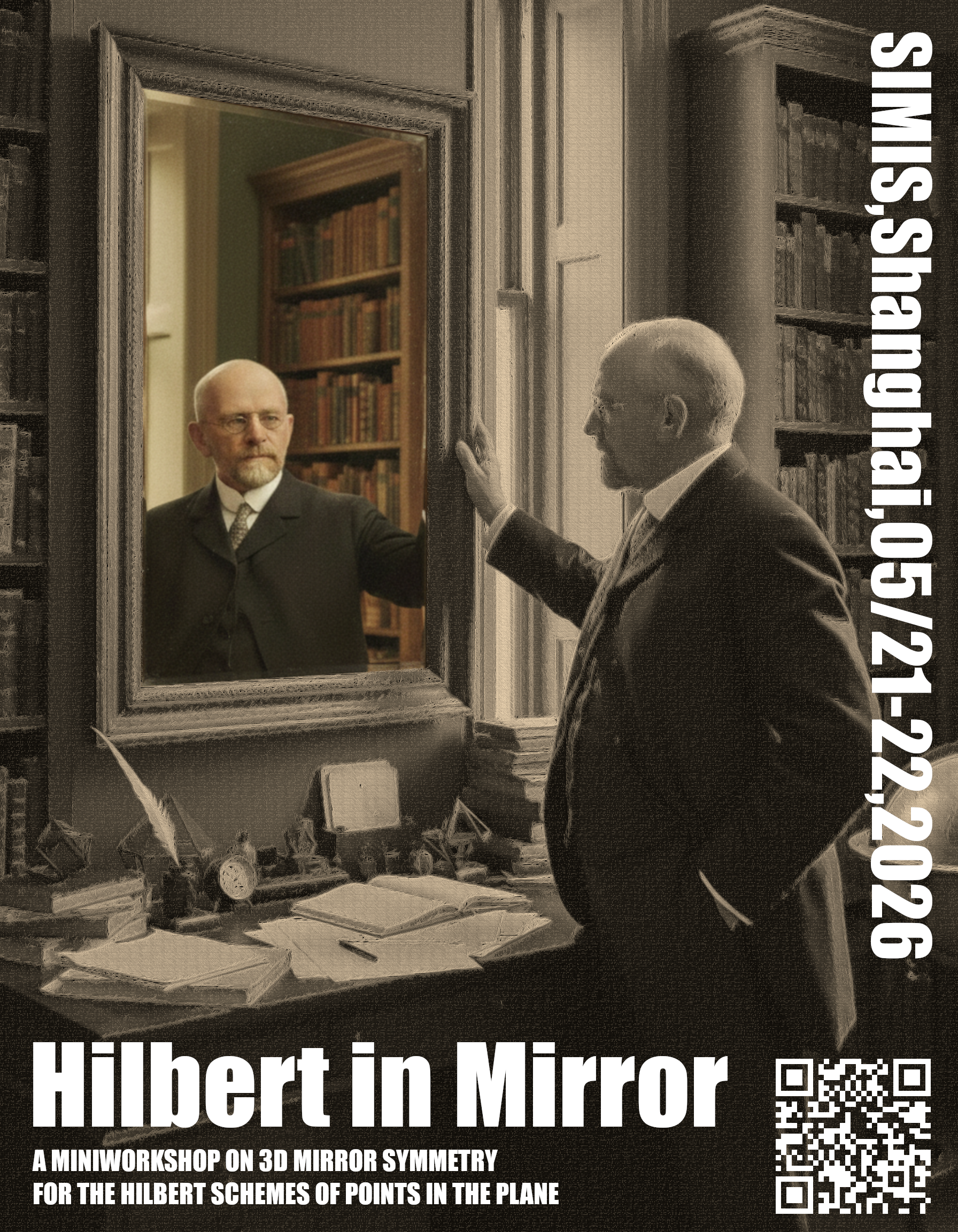
K-theoretic DT/PT counts for local curves in 3-folds are expected to exhibit a very nontrivial and powerful duality as a consequence of the conjectural 3-dimensional mirror symmetry for the Hilbert schemes of points in the plane, as well as from their conjectural relations to counts of membranes in 5-folds. Talks by Rahul Pandharipande, Andrey Smirnov, Yannik Schuler, Zijun Zhou, Tommaso Botta, Andrei Okounkov, and others will present various approaches to these conjectures and related topics. \(\Rightarrow\)website \(\Rightarrow\)poster