MATH V1010:
Groups and Symmetry
Fall 2003
This page is
www.math.columbia.edu/~bayer/F03/symmetry
Section 002 (Bayer)
Tuesdays and Thursdays, 9:10am-10:25am
304 Barnard Hall
Dave Bayer (x42643, 426 Mathematics,
www.math.columbia.edu/~bayer)
Bulletin page |
Directory of Classes :
Mathematics
Student Services Online
Email
My email address is 
Please include the phrase
"Groups and Symmetry Fall 2003"
in the subject line of any correspondence with me concerning this course.
Office Hours
Exams
There will be two exams (30 points each) and a final (40 points). The final is not cumulative.
- First Exam, Tuesday, September 30, in class
- Second Exam, Tuesday, October 28, in class
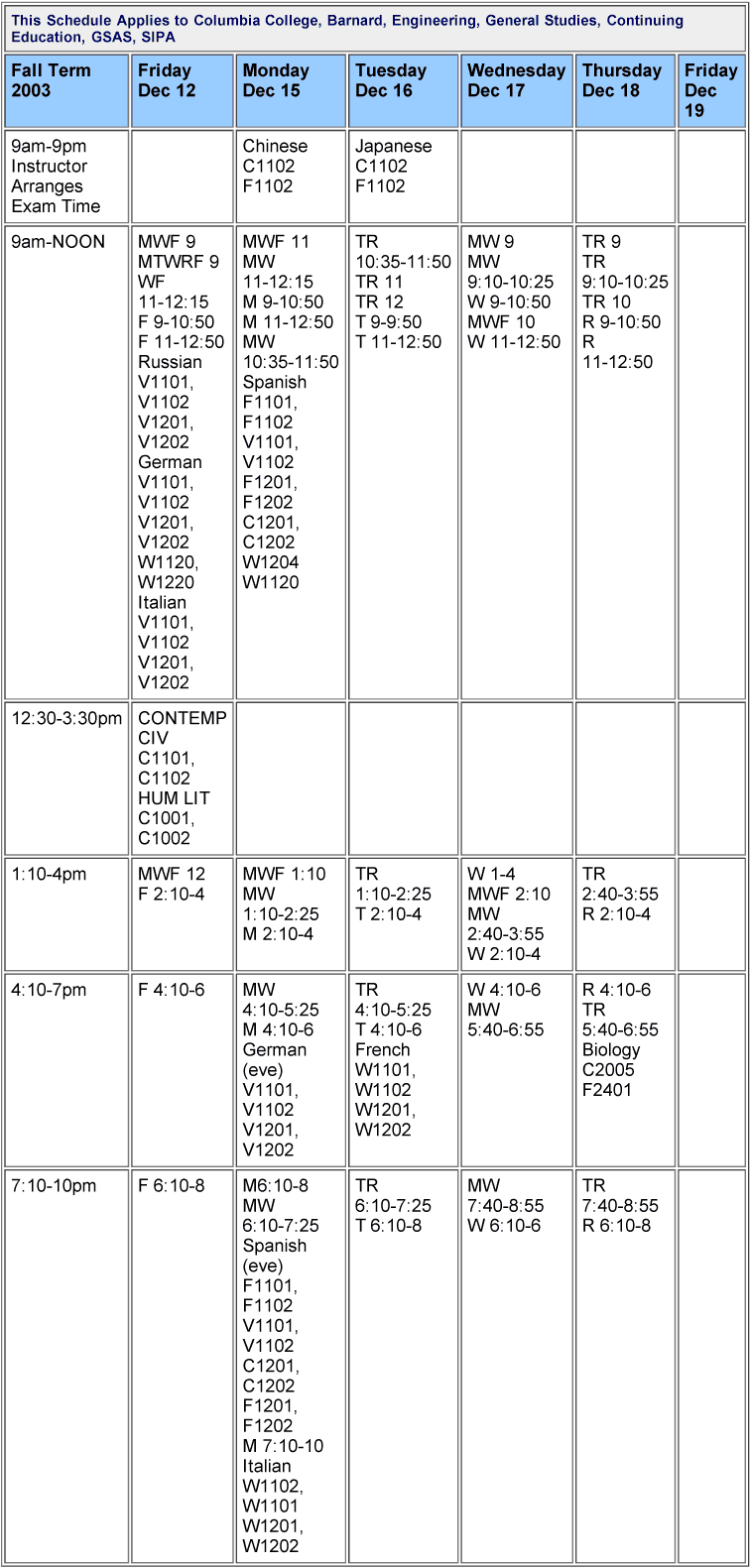
- Final, Thursday, December 18, 9:00am - Noon
These dates do not coincide with any religious holiday which causes suspension of
New York City's alternate side parking regulations; see
NYC Parking Calendar.
Please discuss other conflicts with me well in advance of the exam in question.
Master University Examination Schedule
( Cached )
University Academic Calendar
Attendance and grading
Like most courses in the university, attendance is expected but not
enforced. Please take note of the early meeting hour before registering for
this course. I do not grade this course on a curve; if you elect to miss a
substantial number of classes, you are taking a risk of failing the course.
The material in this course requires a degree of practice that you are at
serious risk of misjudging if you do not attend class.
Class schedule
Tuesday, September 2
Introductory lecture: Symmetries of the square
Thursday, September 4
Symmetries of the square. Groups and subgroups. Assignment 1.
Tuesday, September 9
Multiplication tables for groups. Subgroups and quotient groups. Assignments 2 and 3.
Thursday, September 11
Normal patterns and normals subgroups.
Tuesday, September 16
Patterns, teams, and quotient groups. See last page of
exampletables.pdf,
added Sep 18.
Thursday, September 18
Tuesday, September 23
Thursday, September 25
Tuesday, September 30
Thursday, October 2
Return exams. Introduction to strip diagrams.
Tuesday, October 7
Introduction to strip diagrams.
Last Day to Drop a Class for Barnard, Columbia College, General Studies,
SIPA, GSAS, and Continuing Education.
Thursday, October 9
The seven kinds of strip patterns. Assignment 4.
Tuesday, October 14
Thursday, October 16
Tuesday, October 21
Thursday, October 23
Tuesday, October 28
Thursday, October 30
Tuesday, November 4
No Class
Election Day - University Holiday
Thursday, November 6
Tuesday, November 11
Thursday, November 13
Last Day to Drop a Class for Schools not otherwise noted above.
Last Day to Exercise Pass/Fail option.
Tuesday, November 18
Thursday, November 20
Tuesday, November 25
Thursday, November 27
No Class
Thanksgiving Day - University Holiday
Tuesday, December 2
Thursday, December 4
Thursday, December 18 (projected)
(In past years this final has been held on Thursdays: 12/19/2002, 12/20/2001, 12/21/2000,
and 12/16/1999.)